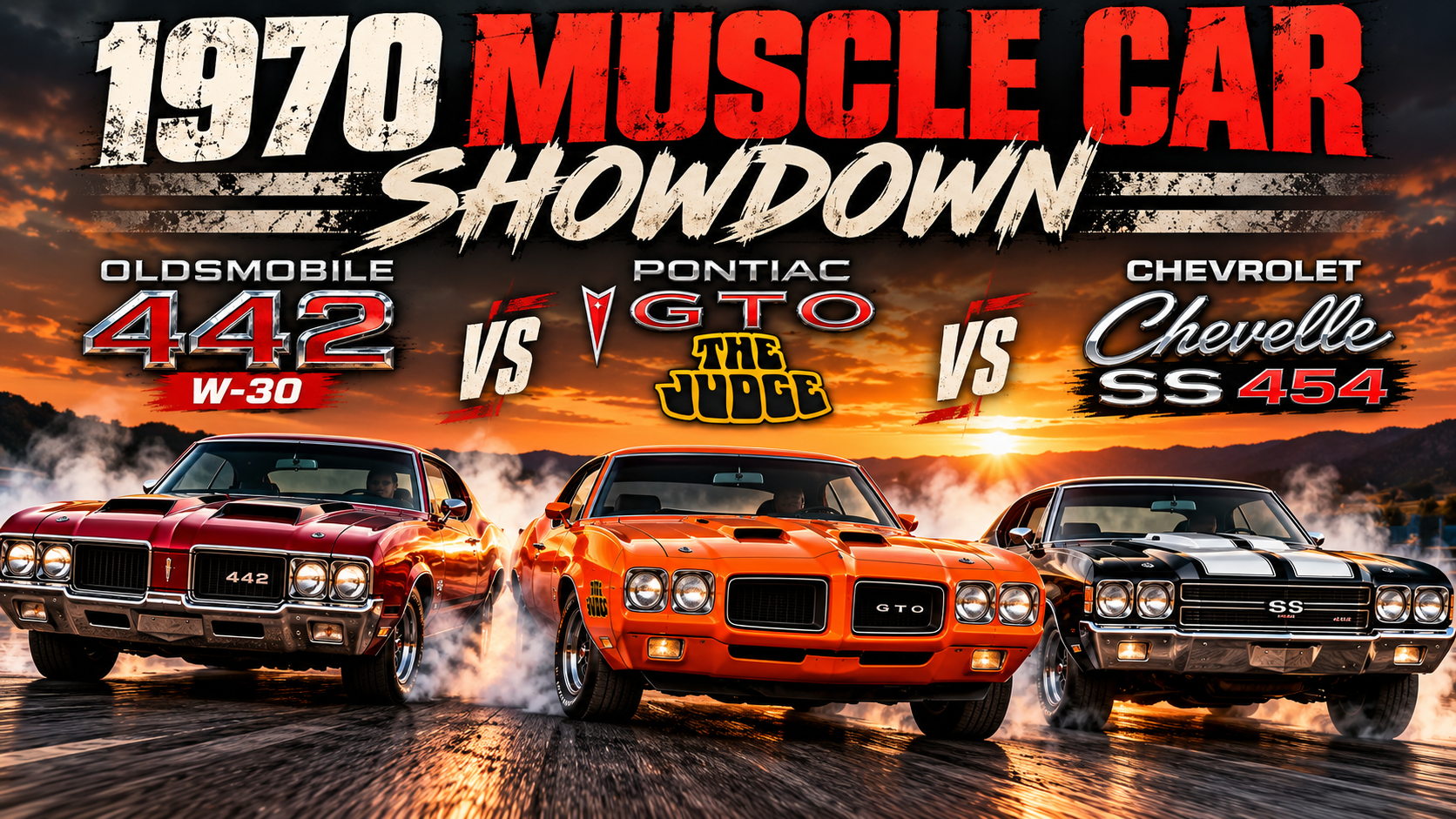
Three GM Legends. Three Different Personalities. One Question: Which Was King?
Muscle Car Showdown – There may never have been a better year to walk into a General Motors dealership with money in your pocket and questionable regard for the rear tires.
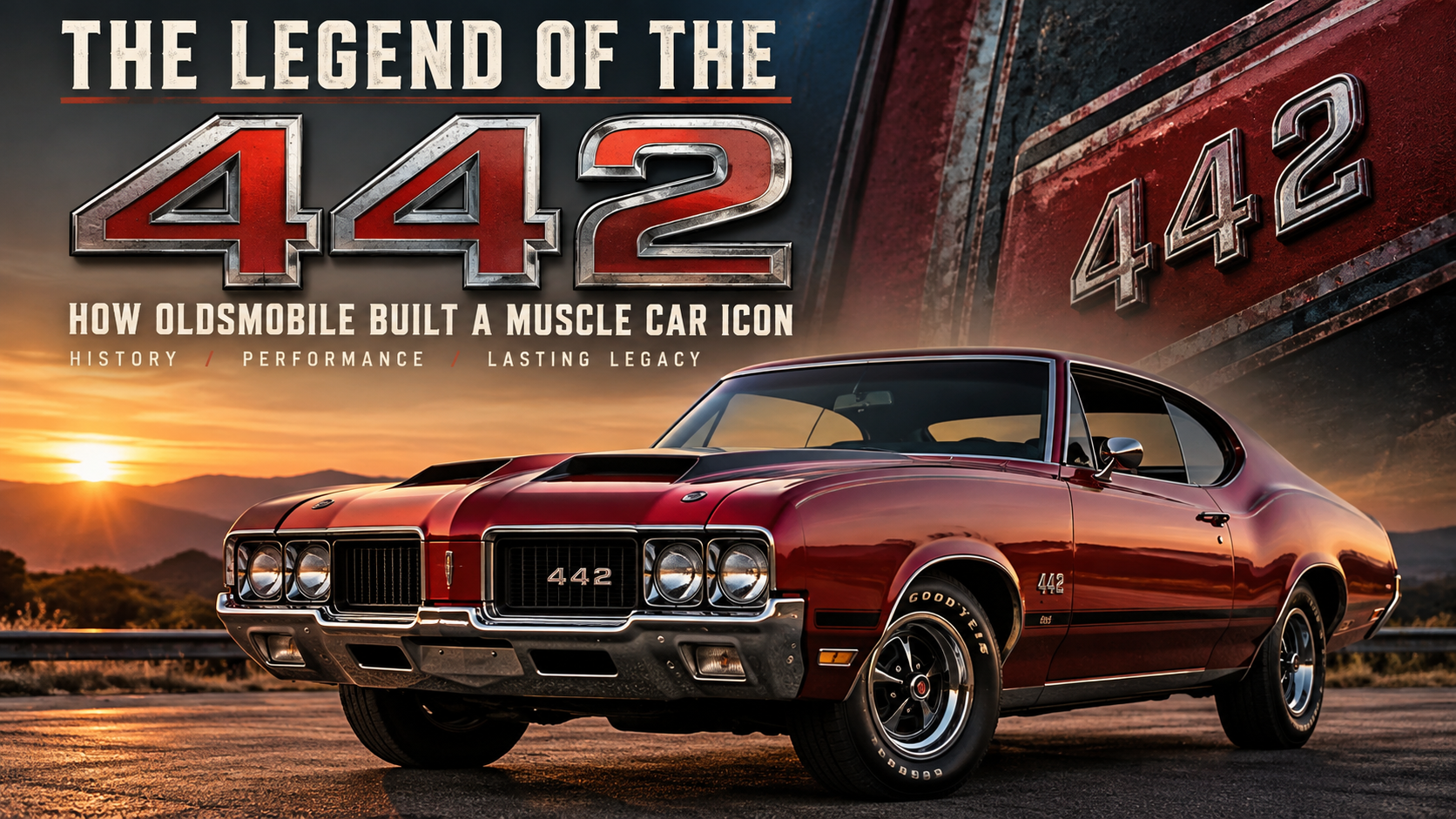
It was 1970, and Detroit’s horsepower war had reached the point of glorious absurdity. Chevrolet would sell you a midsize Chevelle with a 454-cubic-inch V8 officially rated at 450 horsepower. Pontiac offered the flamboyant GTO Judge with its snarling Ram Air engines and a rear wing that announced your arrival before you had even parked. Oldsmobile, meanwhile, took a slightly more sophisticated approach with the 442 W-30, combining 455 cubic inches and 500 lb-ft of torque with the manners of a car you could plausibly drive to a business meeting.
These weren’t merely three fast cars. They represented three different interpretations of the American muscle-car formula, and remarkably, all three came from the same corporation.
So imagine it’s 1970. You’ve got the money. You’ve got an understanding insurance agent. And three sets of keys are sitting on the counter.
1970 Pontiac GTO Judge Ram Air IV.
1970 Chevrolet Chevelle SS 454 LS6.
You can only take one home.
Which one?
That’s where things get interesting.
The Tale of the Tape
Before we start arguing, let’s establish what we’re dealing with.
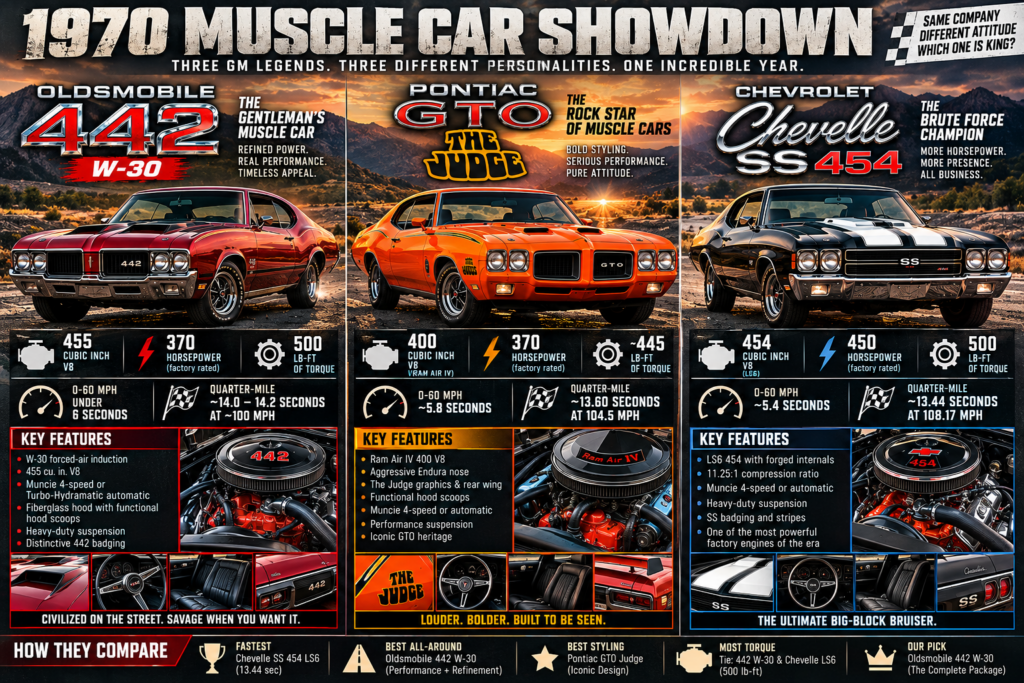
| Car | Engine | Factory HP | Torque | Representative ¼-Mile Performance |
|---|---|---|---|---|
| Oldsmobile 442 W-30 | 455 cu. in. V8 | 370 hp | 500 lb-ft | ~14.0–14.2 sec |
| Pontiac GTO Judge Ram Air IV | 400 cu. in. V8 | 370 hp | ~445 lb-ft | As quick as 13.60 sec |
| Chevelle SS 454 LS6 | 454 cu. in. V8 | 450 hp | 500 lb-ft | As quick as 13.44 sec |
Those quarter-mile numbers require an important disclaimer. Period muscle-car tests varied enormously depending on gearing, transmission, weather, track preparation, tires, driver ability and whether a manufacturer’s press car was exactly as it left the assembly line. Comparing vintage road tests as though they were modern instrumented tests conducted under identical conditions can therefore be misleading.
But the numbers tell us something important anyway.
All three were seriously fast automobiles.
And the Chevrolet was an absolute monster.
Chevrolet Chevelle SS 454 LS6: Bring a Sledgehammer to a Knife Fight
Let’s begin with the obvious brute of the group.
The 1970 Chevrolet Chevelle SS 454 LS6 is one of those automobiles whose specification sheet still makes muscle-car enthusiasts grin more than half a century later.
The engine displaced 454 cubic inches—7.4 liters—and used an 11.25:1 compression ratio, forged internals, solid lifters, an aluminum intake manifold and a big Holley four-barrel carburetor.
Chevrolet rated it at:
450 horsepower at 5,600 rpm.
And:
500 lb-ft of torque at 3,600 rpm.
That wasn’t merely impressive.
It was borderline ridiculous.
MotorTrend’s reproduction of a contemporary road test describes the LS6-equipped Chevelle as an “earth mover,” which might be one of the better descriptions ever applied to an American muscle car. In that test, the four-speed Chevelle ripped through the quarter-mile in 13.44 seconds at 108.17 mph.
Think about that for a moment.
Thirteen-forty-four.
On 1970 tires.
Without electronic traction control, launch control, computer-controlled fuel injection, adaptive suspension or any of the technology that makes modern horsepower manageable.
You had a clutch pedal, a throttle, a steering wheel and approximately 500 lb-ft of torque.
The computer was you.
The LS6 Wasn’t Just a Big Engine
The 454 LS6 wasn’t Chevrolet simply boring out another passenger-car V8 and putting a chrome air cleaner on it.
It featured a forged crankshaft, forged connecting rods, forged aluminum pistons, four-bolt mains, solid lifters and 11.25:1 compression. Contemporary specifications put output at 450 horsepower and 500 lb-ft of torque, delivered through either a heavy-duty Muncie four-speed or Turbo-Hydramatic automatic.
There has also been endless bench-racing speculation that the LS6 made considerably more power than Chevrolet advertised. Hot Rod has noted that enthusiasts have long believed actual output was closer to 500 horsepower.
Whether that folklore is exactly correct almost doesn’t matter.
The LS6’s performance speaks for itself.
If our contest is simply about which of these three cars you’d least like to see pull alongside you at a stoplight, the Chevelle gets the nod.
But muscle cars aren’t judged on quarter-mile slips alone.
And that’s where Oldsmobile enters the argument.
Oldsmobile 442 W-30: The Muscle Car for Grown-Ups
The 442 was never quite as loud about its intentions as the GTO Judge.
Nor did Oldsmobile advertise the kind of headline horsepower number Chevrolet attached to the LS6.
Instead, Oldsmobile created something arguably more interesting.
It built a muscle car with manners.
Under the fiberglass W-25 hood of a 1970 442 W-30 sat Oldsmobile’s enormous 455-cubic-inch V8. Factory output was rated at 370 horsepower, but the number that really mattered was torque.
500 lb-ft.
That’s exactly as much advertised torque as the LS6 Chevelle.
The W-30 package added performance-oriented hardware including forced-air induction, a special camshaft, cylinder heads, carburetor, distributor and aluminum intake manifold. The result was the ultimate expression of Oldsmobile’s muscle-car philosophy: enormous low-end torque combined with a chassis that was surprisingly competent by Detroit standards.
And that distinction matters.
The Chevelle felt like Chevrolet had built an engine and then found a car strong enough to hold it.
The 442 felt like Oldsmobile had engineered the entire automobile.
That’s why the 442 earned its reputation as the gentleman’s muscle car.
It wasn’t soft.
It was civilized.
There is a difference.
A properly equipped 442 W-30 could run the quarter-mile around the low-14-second range, with some period testing dipping even quicker depending on preparation and configuration.
That meant the Oldsmobile wasn’t merely comfortable enough to drive home from the drag strip.
It could hurt feelings while it was there.
Pontiac GTO Judge Ram Air IV: The Rock Star
If the Oldsmobile arrived at the party wearing a sport coat and the Chevelle showed up carrying a tire iron, the Pontiac GTO Judge kicked open the door wearing sunglasses.
This was Pontiac at its most Pontiac.
The GTO had helped create the muscle-car formula in 1964, and by 1970 Pontiac’s marketers had abandoned any remaining interest in subtlety.
The Judge wore wild graphics, Rally II wheels and a huge rear spoiler. Depending on the color, it could look like something Hot Wheels designed after consuming too much coffee.
And that was exactly the point.
Pontiac wasn’t selling transportation.
Pontiac was selling attitude.
The standard Judge came with the potent Ram Air III, but our imaginary buyer is checking the box for the serious engine:
Ram Air IV.
The Ram Air IV displaced only 400 cubic inches—noticeably smaller than the Oldsmobile’s 455 or Chevrolet’s 454—but Pontiac rated it at 370 horsepower.
RM Sotheby’s describes the 400-cubic-inch, 370-horsepower Ram Air IV with a four-speed as arguably one of the most desirable combinations available to GTO enthusiasts.
But here’s where things get interesting.
The Pontiac could run.
Really run.
Super Stock & Drag Illustrated reportedly pushed a Ram Air IV-equipped 1970 Judge through the quarter-mile in 13.60 seconds at 104.5 mph.
That’s close enough to the LS6 Chevelle to make this argument much more entertaining.
And the Pontiac did it with 54 fewer cubic inches.
Round One: Straight-Line Violence
Let’s settle the easiest category first.
Winner: Chevelle SS 454 LS6.
There isn’t much room for debate.
The LS6’s combination of 454 cubic inches, 450 advertised horsepower, 500 lb-ft of torque and enormous performance potential made it arguably the most intimidating engine available in a mainstream GM intermediate.
MotorTrend’s period-test archive recorded 13.44 seconds at 108.17 mph in the quarter-mile.
That’s hauling.
The Ram Air IV Judge deserves enormous respect for producing comparable elapsed times in some tests from a considerably smaller 400-cubic-inch engine, but Chevrolet’s 108-mph trap speed reveals just how much power the LS6 was making.
The Oldsmobile?
Fast.
Very fast.
But if pink slips are sitting on the dashboard and all three cars are stock, I’m taking the LS6.
Round Two: Street Performance
Now things change.
Winner: Oldsmobile 442 W-30.
Quarter-mile racing rewards horsepower, gearing and traction. Driving on the street introduces an entirely different set of priorities.
That’s where 500 lb-ft of Oldsmobile torque becomes addictive.
You didn’t necessarily need to wind the engine toward the top of the tachometer. Put your foot down and the 455 simply pulled.
Hard.
That effortless torque combined beautifully with the 442’s more sophisticated personality. The Olds could cruise comfortably, handle reasonably well for the period and then turn savage when the driver opened the secondaries.
The Chevelle was the more brutal machine.
The Pontiac was arguably more theatrical.
But if I had to drive one every day in 1970, the keys to the W-30 would mysteriously keep finding their way into my pocket.
Round Three: Styling
Now we’re starting a fight.
Winner: Pontiac GTO Judge.
Barely.
All three are beautiful examples of peak-era GM design, but the 1970 Judge looks exactly like what a muscle car should look like.
That Endura nose.
Twin hood scoops.
Rally II wheels.
Eyebrow stripes.
Rear wing.
And colors like Orbit Orange.
There was absolutely nothing apologetic about it.
Pontiac even ran advertising featuring a Ram Air IV Judge accompanied by the wonderfully cocky line:
“After a few moments of respectful silence, you may turn the page.”
That’s fantastic advertising because Pontiac understood exactly what it was selling.
The Chevelle is perhaps the most traditionally handsome of the three, and the 1970 SS’s quad headlights, broad grille and muscular rear quarters have aged beautifully.
The 442 is more restrained.
But the Judge?
The Judge looks like 1970.
Round Four: Engineering and Balance
Winner: Oldsmobile 442 W-30.
This is where Oldsmobile deserves more credit than it usually receives.
The 442’s identity had always involved more than simply installing a bigger engine. From the original 1964 package onward, Oldsmobile paid attention to suspension, handling and overall road behavior.
That philosophy continued into the W-30 era.
The result was a muscle car that didn’t feel quite as one-dimensional as some of its contemporaries.
It was still an old-school body-on-frame Detroit bruiser riding on comparatively primitive tires. Nobody should confuse it with a modern sports sedan.
But within the context of 1970 muscle cars, the Oldsmobile was remarkably complete.
The Chevelle wins the drag strip.
The Olds wins the road trip.
Round Five: Personality
This one can’t be measured with a stopwatch.
And I’m giving it to the GTO Judge.
The Judge simply has charisma.
Everything about it reflects the glorious lunacy of the muscle-car era, when automobile manufacturers named cars things like Judge, Road Runner, Super Bee and Demon and somehow convinced corporate executives that this was perfectly reasonable.
The GTO also carries something the others can’t replicate.
Heritage.
The 1964 GTO is generally regarded as one of the automobiles that established the classic muscle-car formula: take an ordinary midsize American car, install a big engine and sell it to young people who enjoy turning gasoline into noise.
By 1970, the Judge represented the wild culmination of that idea.
And the Ram Air IV made sure the performance backed up the graphics.
Round Six: The Engine We’d Most Like in Our Garage
Winner: Chevrolet 454 LS6.
No contest.
Four hundred and fifty advertised horsepower.
Five hundred pound-feet.
Eleven-and-a-quarter-to-one compression.
Solid lifters.
Big Holley carburetor.
Forged internals.
Muncie four-speed.
If the phrase American muscle car engine creates a mental image, this is probably close to it.
There are engines that are faster today.
There are engines that make twice the horsepower while idling smoothly enough to balance a glass of water on the intake manifold.
That’s beside the point.
The LS6 came from an era when engines sounded mechanical because they were mechanical.
You didn’t plug a laptop into one.
You grabbed a wrench.
The Verdict
So which one wins?
If we’re awarding the championship based strictly on raw performance:
1. Chevrolet Chevelle SS 454 LS6
The LS6 is simply too much engine to ignore. Its 450-horsepower rating made it one of the headline powerplants of the muscle-car era, and contemporary testing confirms that the numbers translated into ferocious real-world performance. A 13.44-second quarter-mile at more than 108 mph was serious business in 1970.
If you’re standing at the drag strip with money on the race, take the Chevrolet.
But suppose the question changes.
Suppose you’re not asking which is fastest.
Suppose you’re asking:
Which one would you actually want to own?
Then my answer changes.
2. Oldsmobile 442 W-30
This would be my choice.
The W-30 gives away some ultimate straight-line performance to the LS6, but what you get in return is one of the most complete muscle cars Detroit ever produced.
You’ve got 455 cubic inches.
You’ve got 500 lb-ft of torque.
You’ve got functional forced-air induction.
You’ve got aggressive styling without looking like you’re trying too hard.
And you’ve got something increasingly valuable in the collector-car world:
A car that isn’t the obvious choice.
Pull into a show with a Chevelle SS and people will admire it.
Pull into a show with a real 1970 442 W-30 and the guys who really know muscle cars will start walking toward you.
There’s something appealing about that.
3. Pontiac GTO Judge Ram Air IV
Putting the Judge third almost feels insulting because this is an extraordinary automobile.
The Ram Air IV is one of Pontiac’s legendary performance engines. The styling is unmistakable. The GTO name carries enormous historical significance. And period testing showing 13.60-second quarter-mile capability proves the Judge wasn’t merely a marketing exercise.
In fact, if the question were which car best represents the entire muscle-car era, the Judge might win.
But somebody has to finish third.
And in this company, there’s no shame in bronze.
Three Cars That Explain Why We Still Love Muscle Cars
Here’s the real answer.
Nobody loses.
The fact that one corporation offered these three automobiles simultaneously tells you everything you need to know about how extraordinary the American performance market had become by 1970.
Chevrolet gave us the hammer.
Pontiac gave us the showman.
Oldsmobile gave us the gentleman bruiser.
All three approached the same basic formula differently, and all three created legends.
That’s something worth remembering when looking at horsepower numbers alone. Modern cars are astonishingly fast. A contemporary family sedan can produce acceleration that would have humiliated many legendary muscle cars.
But performance statistics don’t completely explain why we love automobiles.
Character does.
A modern engine computer can make hundreds of calculations before you’ve finished moving your foot toward the throttle. These cars asked the driver to handle everything personally.
Too much throttle?
That’s your problem.
Missed the shift?
Your problem.
Rear tires disappearing in a cloud of white smoke?
Technically your problem—but also one of the reasons you bought the damn thing.
The LS6 Chevelle, Ram Air IV Judge and W-30 Oldsmobile came from a short period when Detroit’s engineers were given increasingly powerful engines and seemingly told:
Go have some fun.
They did.
And more than half a century later, we’re still arguing over which one was best.
Exactly as we should be.
The Manly Arts Garage Verdict
Fastest Bruiser: Chevrolet Chevelle SS 454 LS6
Best Styling and Personality: Pontiac GTO Judge Ram Air IV
Best All-Around Muscle Car: Oldsmobile 442 W-30
Car We’d Take Home: 1970 Oldsmobile 442 W-30
The Chevelle might beat it at the drag strip.
The Judge might attract more attention at the drive-in.
But the W-30 is the one we’d want sitting in the garage when Saturday morning arrives.
Fire the 455.
Let it warm up.
Find an empty piece of road.
And remember why Detroit’s greatest era wasn’t measured solely in horsepower.
It was measured in cubic inches, tire smoke and attitude.