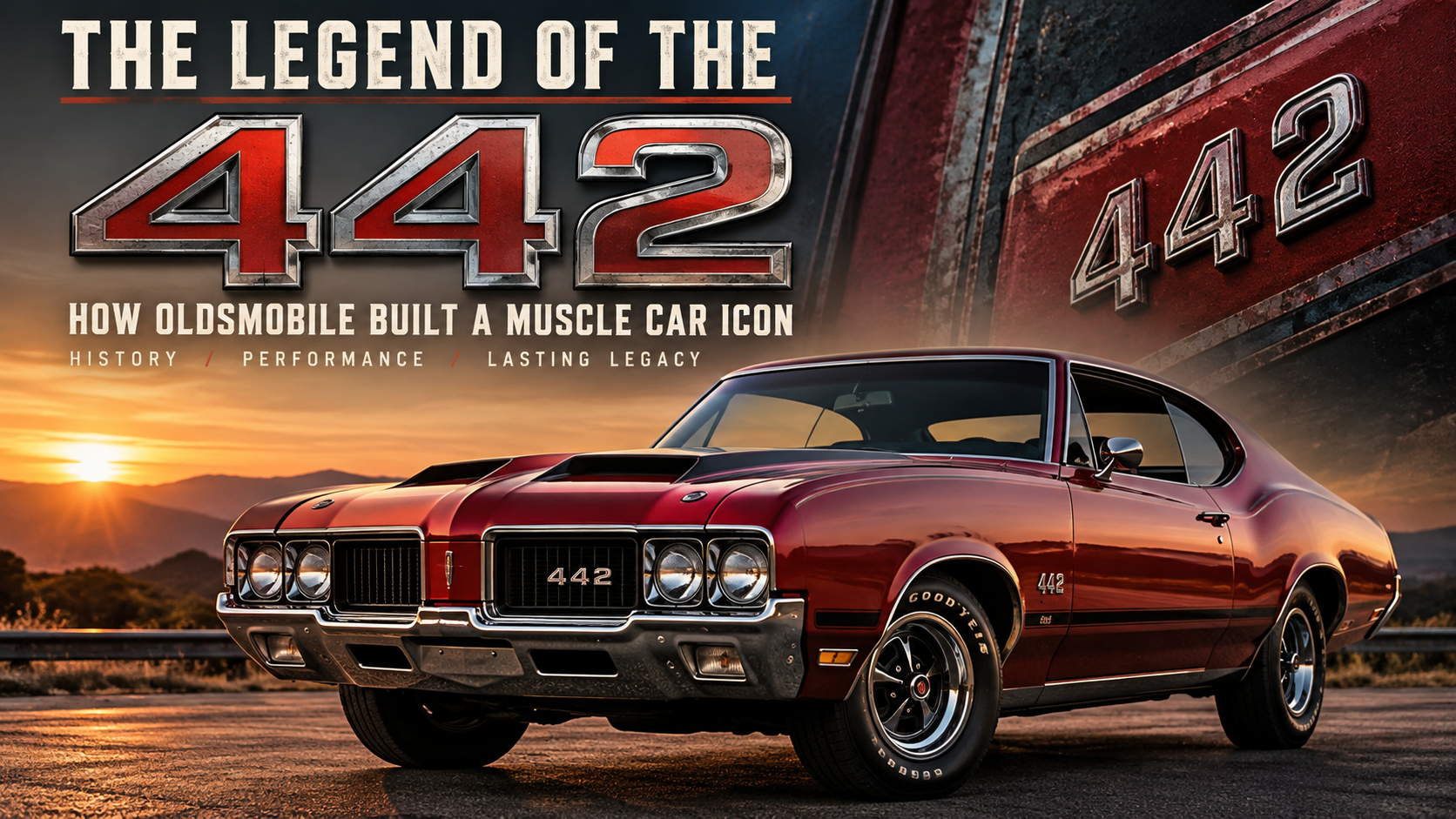
The Oldsmobile 442 – There was a glorious moment in American automotive history when horsepower was cheap, gasoline was cheaper, and Detroit engineers seemed to spend their working hours figuring out increasingly creative ways to stuff enormous V8 engines into cars that had absolutely no business being that fast. Pontiac had the GTO. Chevrolet unleashed the Chevelle SS. Plymouth brought the Road Runner and GTX. Dodge came armed with the Charger and Coronet R/T. Ford answered with the Torino Cobra and a seemingly endless supply of big-block engines.
And then there was Oldsmobile.
Oldsmobile wasn’t supposed to be the wild child of General Motors. It occupied the respectable middle ground of GM’s hierarchy—a little more sophisticated than Chevrolet or Pontiac, less ostentatious than Cadillac, and aimed squarely at the successful American who wanted performance without necessarily advertising it from three blocks away. Then, in 1964, somebody at Oldsmobile apparently loosened his tie, rolled up his sleeves, and decided respectable people deserved to smoke their rear tires too.
The result was the Oldsmobile 4-4-2, more commonly written simply as the 442, and it became one of the most formidable—and arguably most underrated—muscle cars of the entire era.
The 442 could cruise quietly down the boulevard with four adults aboard, looking almost dignified while doing it. But put your right foot down and the big Olds revealed an entirely different personality. By 1970, the ultimate W-30 version was packing 455 cubic inches, a factory-rated 370 horsepower and a pavement-wrinkling 500 lb-ft of torque.
The gentleman had brass knuckles in his pocket.
The Muscle-Car War Comes to Oldsmobile
To understand the 442, you have to go back to 1964, when Pontiac essentially threw a lit match into a room filled with gasoline.
Pontiac engineer John DeLorean and his team had figured out that young buyers might enjoy a midsize automobile with a large engine stuffed under the hood. The resulting Pontiac GTO helped ignite the muscle-car phenomenon, and suddenly every division in Detroit needed an answer.
Oldsmobile’s response arrived quickly.
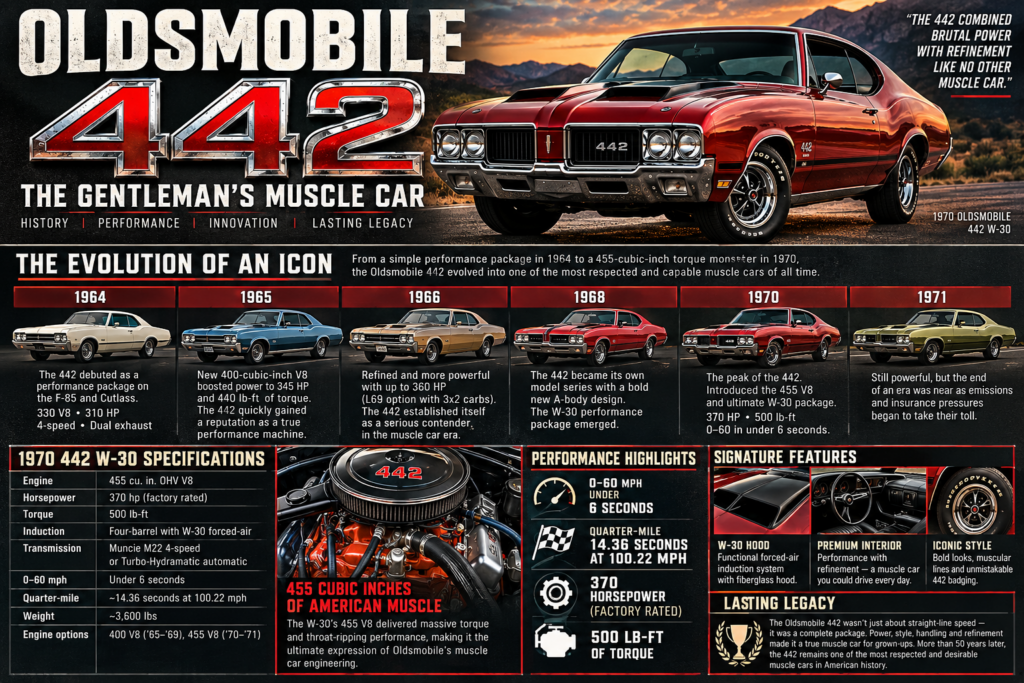
The first 442 wasn’t technically a separate automobile at all. Introduced during the 1964 model year, it was a performance package—option code B09—available on Oldsmobile’s midsize F-85 and Cutlass.
The name originally described exactly what the buyer was getting:
4-barrel carburetor.
4-speed manual transmission.
2 exhaust pipes.
Hence, 4-4-2.
Under the hood sat Oldsmobile’s 330-cubic-inch V8 producing a factory-rated 310 horsepower. The package also included a high-lift camshaft, heavy-duty suspension components, wider wheels, redline tires and other performance upgrades. Interestingly, many of the components used to create the original 442 came from Oldsmobile’s police packages.
It wasn’t merely an engine option. Oldsmobile wanted the entire car to perform.
MotorTrend’s historical examination of the early 442 notes that the original package cost just $136 and that only 2,999 cars received the 442 treatment in 1964. The idea caught on quickly: approximately 25,000 were built the following year.
The muscle-car arms race was officially underway.
1965: Now We’re Getting Serious
If the original 330-powered 442 was Oldsmobile dipping its toe into the performance market, the 1965 model was Oldsmobile diving into the deep end.
The 330 disappeared.
In its place came a 400-cubic-inch V8 producing 345 horsepower and 440 lb-ft of torque.
That was serious power in 1965.
The meaning of “442” consequently became a little fuzzy. With other transmissions becoming available, the original four-barrel/four-speed/dual-exhaust formula no longer necessarily described every car carrying the badge. Eventually, 442 simply became a name—and one of the most recognizable combinations of numbers in American performance history.
By 1966, the standard 400 produced approximately 350 horsepower, while the optional L69 setup used three two-barrel carburetors to raise output to 360 horsepower.
One original L69 owner interviewed by MotorTrend, Bob Kanas, remembered cruising Detroit and encountering the inevitable street challenges from rival muscle cars.
His wonderfully concise assessment?
“Killed them Goats, killed them Fairlanes.”
“Goats,” of course, meant Pontiac GTOs.
That pretty much tells you what you need to know about muscle-car culture in 1966.
Enter the W-30
Then Oldsmobile’s engineers got ambitious.
The now-legendary W-30 performance package emerged during this period and would eventually become synonymous with the hottest versions of the 442. Early W-30 cars incorporated an outside-air induction system designed to feed cooler air into the engine, along with other performance modifications.
It wasn’t simply decorative hood scoops and stripes. The W-30 represented Oldsmobile’s serious factory performance program.
And that’s an important distinction because the 442 developed a character different from many of its competitors.
The Pontiac GTO had swagger. A Plymouth Road Runner could be wonderfully crude. Chevrolet’s SS models often felt like street racers that happened to have license plates.
The 442 was different.
It was fast, but it was also sophisticated.
MotorTrend has described the 442 as the GTO’s “more refined brother, with better handling.” That refinement would become the car’s calling card.
The Oldsmobile wasn’t trying to be a stripped-down dragster. It was a muscle car a grown man could drive to the office Monday morning after spending Sunday afternoon embarrassing people at the drag strip.
1968: The 442 Becomes Its Own Car
For 1968, the 442 graduated from option-package status and became its own model series.
The redesigned GM A-body platform gave the Oldsmobile a muscular new shape with a shorter wheelbase, broad shoulders and the long-hood/short-deck proportions that have come to define the classic American muscle car.
The 400-cubic-inch V8 remained the heart of the machine, while the W-30 continued to occupy the top of the performance hierarchy.
By this point, America’s muscle-car war was becoming wonderfully ridiculous.
Walk into the right dealership with enough money and you could choose among cars carrying names like GTO, SS 396, Road Runner, GTX, Charger R/T, Cobra Jet, GS, Cyclone and 442.
Every manufacturer was looking for another five horsepower, another tenth of a second and another advantage at the stoplight.
But the biggest change was still coming.
1970: The 442 Reaches Its Peak
If one year captures the Oldsmobile 442 at its most magnificent, it is 1970.
General Motors relaxed its corporate restriction limiting engine displacement in midsize cars, and Oldsmobile engineers responded exactly as any sensible group of horsepower-obsessed Americans would have.
They installed a 455-cubic-inch V8.
That’s approximately 7.5 liters of naturally aspirated Detroit iron.
The standard 1970 442’s 455 was rated at 365 horsepower, while the W-30 version increased output to 370 horsepower. More impressive was the torque: approximately 500 lb-ft.
GM’s own Heritage Collection calls the W-30 the “ultimate high-performance Oldsmobile.” Its package included the 455 V8, forced-air induction, special air cleaner, aluminum intake manifold, fiberglass hood, performance-oriented equipment and distinctive W-30 identification.
Buyers could pair that monster with transmissions including the legendary Muncie M22 “Rock Crusher” four-speed or a Turbo-Hydramatic automatic.
And the performance was legitimate.
Hagerty’s historical specifications put a properly equipped 1970 442 W-30 at under six seconds from 0–60 mph, with the quarter-mile dispatched in approximately 14.36 seconds at 100.22 mph.
Remember: this was a large, comfortable American automobile riding on 1970 tires, carbureted, without traction control, launch control or computers deciding how much throttle the driver could handle.
You controlled 500 lb-ft of torque with your right foot.
Good luck.
1970 Oldsmobile 442 W-30: The Numbers
At its peak, the specification sheet looked something like this:
Engine: 455-cubic-inch (7.5-liter) OHV V8
Induction: Four-barrel carburetor with W-30 forced-air induction
Horsepower: 370 hp (factory rating)
Torque: Approximately 500 lb-ft
Drive: Rear-wheel drive
Transmission: Manual or Turbo-Hydramatic automatic
0–60 mph: Under 6 seconds in period testing
Quarter-mile: Approximately 14.36 seconds at 100.22 mph
Wheelbase: 112 inches
Length: Approximately 203 inches
Those numbers placed the W-30 squarely among the heavy hitters of the golden muscle-car era.
And it looked fantastic doing it.
The 1970 car’s twin hood scoops, aggressive grille, optional rear spoiler, muscular fenders and beautifully proportioned roofline gave it menace without cartoonish excess. W-30 cars added that distinctive fiberglass hood and functional induction system.
Oldsmobile even supplied the 1970 Indianapolis 500 pace car, cementing the 442’s place in American performance culture.
The 442 vs. the Muscle-Car Heavyweights
Calling the 442 quick requires some perspective because its competitors were among the most legendary American automobiles ever manufactured.
The Chevrolet Chevelle SS 454 LS6 offered a factory-rated 450 horsepower. Chrysler had the 426 Hemi. Buick’s GS 455 Stage 1 produced extraordinary torque. Pontiac’s Ram Air GTOs were formidable, and Ford’s Cobra Jet engines could turn otherwise innocent-looking intermediates into terrifying stoplight weapons.
The 442 nevertheless belonged in that company.
What distinguished it wasn’t necessarily winning every horsepower contest. It was how Oldsmobile combined performance with road manners and refinement.
The 442 had always been engineered as more than an engine surrounded by sheet metal. Heavy-duty suspension equipment and anti-roll bars helped make early examples unusually competent compared with many contemporaries. MotorTrend’s retrospective noted that early 442s handled surprisingly well for muscle cars and describes later examples as stylish, quick and refined.
That created an unusual personality.
A Road Runner was a barroom brawler.
The GTO was the charismatic rebel.
The Chevelle SS was the street racer’s favorite weapon.
The Oldsmobile 442 was the guy sitting quietly at the end of the bar wearing an expensive watch who, as you eventually discovered, could knock you unconscious.
When the Horsepower Party Ended
Unfortunately, Detroit’s horsepower celebration couldn’t last forever.
Insurance companies were raising rates on high-performance automobiles. Emissions requirements were tightening. Leaded premium gasoline was on borrowed time. Compression ratios dropped, manufacturers switched from optimistic SAE gross horsepower ratings to more realistic SAE net figures, and the approaching oil crisis would fundamentally change the American automobile industry.
The 1971 442 W-30 was still legitimately quick. MotorTrend recorded an automatic-equipped example reaching 60 mph in 6.1 seconds and running the quarter-mile in 14.4 seconds at 97 mph.
But the direction was obvious.
For 1972, the 442 returned to being an option package rather than a standalone model. The name survived through the 1970s, disappeared briefly, and eventually returned on performance-oriented Cutlass models during the 1980s and early 1990s. Hagerty’s historical overview places the final production-era 442 in 1991.
The glory years, however, would always be 1964 through 1971—and especially 1970.
More Than Just Another Muscle Car
Today, the Oldsmobile 442 occupies a fascinating place in collector-car culture.
Ask the average person to name an American muscle car and you’ll probably hear Mustang, Camaro, Charger or GTO before anyone mentions Oldsmobile. That’s partly because Oldsmobile itself disappeared in 2004, ending a remarkable history stretching back more than a century.
But enthusiasts know.
They know what W-30 means.
They know why a genuine 1970 W-30 attracts attention.
They know that beneath the comparatively restrained Oldsmobile styling could live one of the nastiest big-block V8s of the era.
And they understand that the 442 represented something slightly different from the stereotypical muscle car.
It had muscle without sacrificing maturity.
That’s why the description “gentleman’s muscle car” fits so well.
The 442 could rumble through town with the air conditioning blowing, the automatic transmission in Drive and a passenger comfortably riding beside you. But bury the throttle and that civilized Oldsmobile suddenly became 455 cubic inches of carbureted American violence.
That dual personality is a large part of its enduring appeal.
The Oldsmobile That Refused to Act Its Age
Perhaps the best thing about the 442 is what it tells us about Oldsmobile itself.
This was a company with a reputation for engineering and sophistication that briefly found itself caught up in America’s horsepower war—and rather than merely participating, Oldsmobile’s engineers built one of the finest all-around muscle cars of the era.
The original 1964 442 began modestly enough: a $136 performance package consisting of a hotter 330 V8, four-barrel carburetor, four-speed transmission, dual exhaust and upgraded suspension.
Six years later, it had evolved into the W-30: 455 cubic inches, 370 horsepower, 500 lb-ft of torque and quarter-mile capability in the low-14-second range.
That’s quite an evolution.
The muscle-car era produced automobiles that were faster on paper. Others became more famous. Some now command even more astronomical prices at auction.
But very few combined brutality and civility as successfully as the Oldsmobile 442.
It was a muscle car for the man who wanted horsepower but didn’t feel compelled to shout about it.
And perhaps that’s why, more than sixty years after the first 442 rolled onto American streets, those three numbers still mean something.
4-4-2.
You don’t need to explain them to the people who know.
Further Reading
For original factory information and specifications, the GM Heritage Collection’s 1970 Oldsmobile 442 archive is an excellent starting point, while GM also maintains its archive of original Oldsmobile vehicle information kits.
For collector history and model-year information, see Hagerty’s Oldsmobile 4-4-2 guide and its detailed 1970 442 W-30 specifications and history.
For driving impressions and period-oriented enthusiast history, MotorTrend’s retrospective on the 1964–1967 Oldsmobile 442 provides particularly good context on what made the early cars different from their competitors.