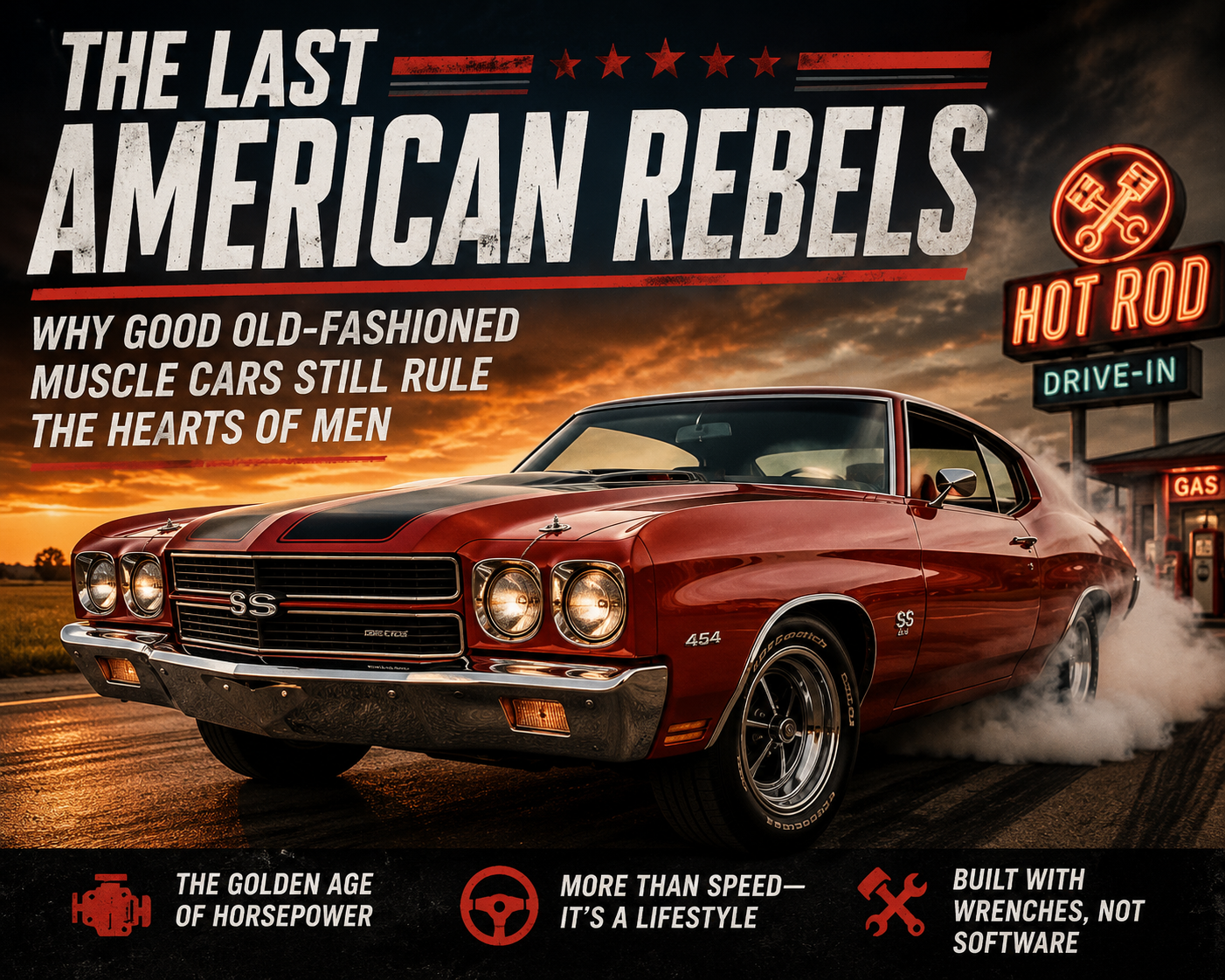
Why Good Old-Fashioned Muscle Cars Still Rule the Hearts of Men
Muscle Car Madness – There comes a moment in every gearhead’s life when horsepower stops being just a number on a spec sheet and becomes something deeply personal. It isn’t measured in quarter-mile times or dyno charts, but in memories—the first time you heard the unmistakable lope of a big-block camshaft echo through the neighborhood, the smell of race fuel hanging in the cool evening air, or the vibration of a V8 that seemed to shake the entire earth every time the throttle was cracked open. Those moments leave a permanent mark, and for generations of men they have created a lifelong obsession with American muscle cars that refuses to fade, no matter how advanced the automotive world becomes.
Today we live in an era where electric supercars can embarrass million-dollar exotics at the drag strip, where computers make split-second decisions faster than any driver ever could, and where performance is increasingly measured by software updates instead of cubic inches. Modern performance cars are engineering marvels, capable of breathtaking acceleration while insulating their occupants from noise, vibration, and even the consequences of poor driving. Yet for all of their technological brilliance, they often leave enthusiasts longing for something they cannot manufacture with algorithms or electric motors: character.
Character is what made the golden age of American muscle cars unforgettable. Between 1964 and the early 1970s, Detroit found itself locked in what historians now call the Horsepower Wars, an era when engineers—not accountants—seemed to be running the show. Every manufacturer wanted to build the fastest car on Woodward Avenue, dominate weekend drag strips across America, and earn bragging rights that would last until next year’s model rolled off the assembly line. Pontiac ignited the revolution with the GTO, proving that dropping a full-sized V8 into a midsize coupe was a recipe for instant success. Chevrolet answered with the Chevelle SS, Ford unleashed increasingly outrageous Mustangs, and Chrysler turned Mopar into a four-letter word that struck fear into competitors with HEMI-powered Chargers, Challengers, Super Bees, and Road Runners. Horsepower ratings climbed at a dizzying pace, styling grew more aggressive every year, and buyers couldn’t get enough.
These cars represented something much larger than transportation. They embodied an American spirit built on freedom, confidence, and individuality. They were machines designed during a period when the open road still symbolized limitless possibility and when owning a powerful automobile meant independence in its purest form. Young men gathered at drive-ins on Friday nights, cruised downtown boulevards with the windows rolled down, and challenged one another to stoplight races that became the stuff of local legend. A muscle car wasn’t simply something you drove to work; it was an extension of your personality and often your reputation.
Hollywood understood this almost immediately. Steve McQueen transformed the 1968 Mustang GT Fastback into an international icon during the unforgettable chase scene in Bullitt. The Dodge Challenger became forever linked to freedom and rebellion in Vanishing Point. Burt Reynolds turned the black-and-gold Pontiac Trans Am into a rolling symbol of outlaw cool in Smokey and the Bandit. These films didn’t create the mystique surrounding muscle cars—they simply amplified what millions of Americans already believed. A muscle car represented confidence without apology, power without compromise, and a willingness to live life with the throttle wide open.
That emotional connection is perhaps the biggest reason these machines continue to captivate men decades after their production ended. Ask any classic muscle car owner why he spends weekends underneath a Chevelle instead of playing golf, or why he’s willing to chase down impossible-to-find factory parts for a 1970 Plymouth ‘Cuda, and you’ll rarely hear him begin with horsepower figures. Instead, he’ll tell you about his father teaching him how to adjust a carburetor, about watching drag races as a child, or about the first time he heard open headers echo through the grandstands. These stories reveal that muscle cars are less about transportation than they are about memory. They remind us of family, youth, and simpler times when solving a problem usually required a socket wrench instead of a software update.
There is also something profoundly satisfying about the mechanical honesty of these automobiles. Open the hood of a classic Camaro or Charger and every major component is right there in front of you. You can see how the engine breathes, how the carburetor mixes fuel and air, how the distributor sends spark to each cylinder, and how every moving part contributes to the thunder coming from the exhaust pipes. Modern cars often require diagnostic computers before you can even identify a problem, but a classic muscle car invites its owner to participate in the experience. It rewards curiosity, patience, and mechanical skill in ways few contemporary vehicles ever could.
Jay Leno once remarked, “Cars are the sculptures of our everyday lives.” Few vehicles embody that philosophy better than America’s muscle cars. Their sweeping body lines, aggressive hood scoops, polished chrome, and impossibly long hoods were designed not merely to transport people but to stir emotion. Even standing still, a 1969 Dodge Charger or 1970 Chevrolet Chevelle SS appears ready to leap forward, as though the designers somehow captured motion in sheet metal. That timeless styling explains why these cars continue drawing crowds wherever they appear. Children stop to stare because they have never seen anything quite like them, while older enthusiasts pause because they remember exactly what these machines meant during their youth.
The muscle car community itself has become one of the hobby’s greatest attractions. Attend any Cars & Coffee gathering, drag strip, or local cruise night, and you’ll quickly discover that ownership is merely the admission ticket into a nationwide fraternity of enthusiasts. Conversations begin with engine combinations and restoration projects but inevitably evolve into stories about family, road trips, and lifelong friendships. According to research conducted by the Specialty Equipment Market Association (SEMA), younger generations continue entering the collector-car hobby in significant numbers, proving that the appeal of classic American performance is not disappearing—it is simply being passed from one generation to the next. The faces may change, but the passion remains remarkably constant.
The automotive landscape will continue evolving. Electric vehicles will become faster, autonomous driving systems more sophisticated, and performance numbers increasingly astonishing. Yet none of those advances are likely to replace the visceral experience of sitting behind the wheel of a four-speed Chevelle, hearing the idle settle into a rhythmic lope, and feeling several hundred cubic inches of Detroit iron come alive beneath your right foot. Muscle cars endure because they satisfy something deeper than our desire for speed. They remind us that driving can be emotional rather than merely efficient, mechanical rather than digital, and unforgettable rather than forgettable.
Long after the last gallon of premium gasoline has been pumped and the final manual transmission rolls off an assembly line, there will still be men gathered around old American V8s, swapping stories, turning wrenches, and smiling every time another engine roars to life. That isn’t nostalgia. It’s proof that some machines transcend transportation and become part of who we are. American muscle cars earned that distinction decades ago, and judging by the passion they continue to inspire, they aren’t about to surrender it anytime soon.