
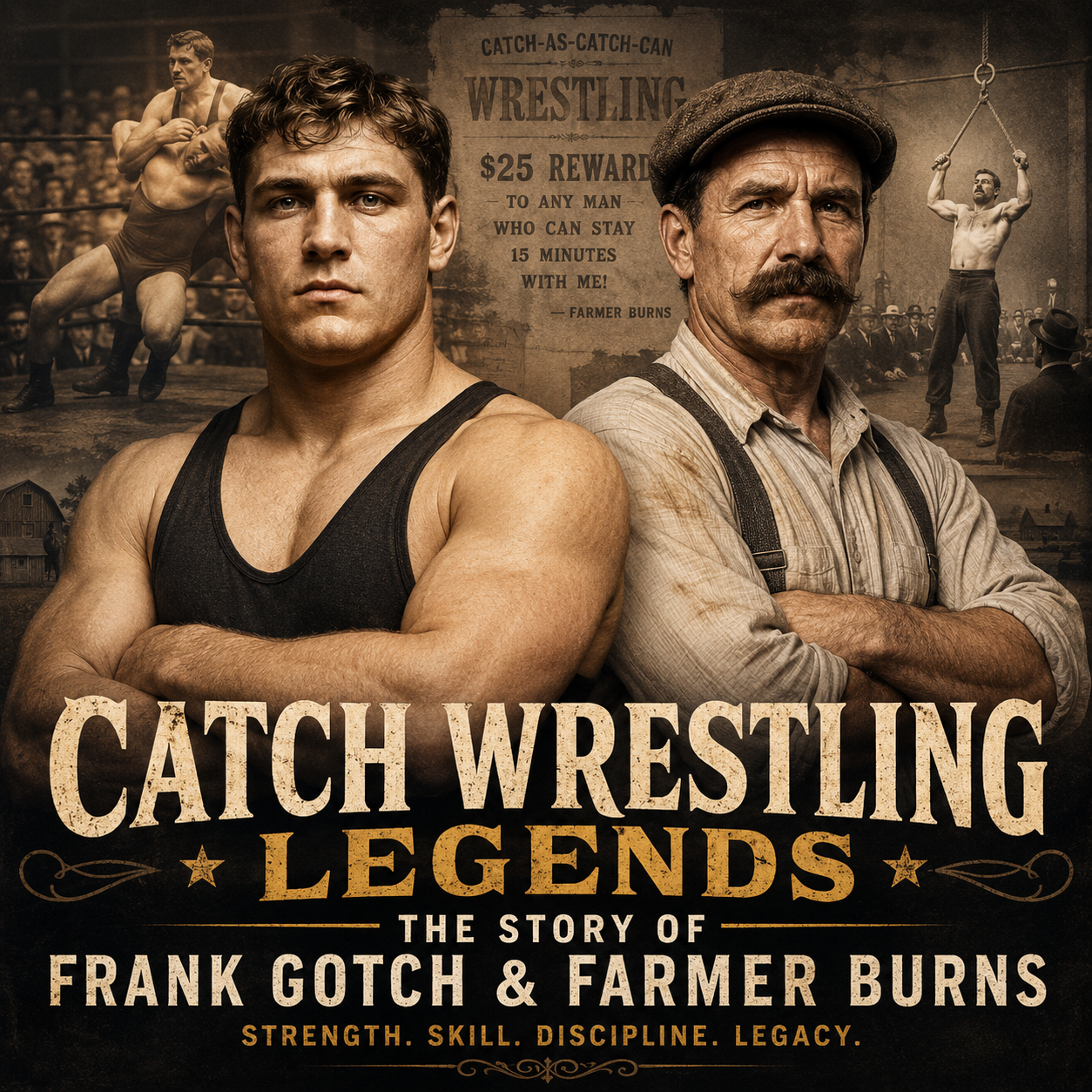
The Incredible Story of Frank Gotch and Farmer Burns
Catch Wrestling Legends – Before the bright lights of WWE arenas, before Olympic wrestling became a household sport, and long before mixed martial arts introduced the world to submission grappling, there was catch-as-catch-can wrestling.
This wasn’t choreographed entertainment. It wasn’t about championship belts made of gold-plated leather or carefully scripted rivalries. Catch wrestling was a brutal proving ground where reputations were earned through broken bones, painful submission holds, and the willingness to face anyone who stepped onto the mat.
Two men came to define this golden age of American wrestling more than any others: Martin “Farmer” Burns, the scientific mastermind who revolutionized wrestling instruction, and Frank Gotch, the farm boy who became the most dominant wrestler on Earth.
Together, mentor and student forged a legacy that still influences wrestling, Brazilian Jiu-Jitsu, submission grappling, and mixed martial arts more than a century later.
The Birth of Catch Wrestling
Wrestling is one of humanity’s oldest sports. Archaeologists have discovered cave paintings dating back over 5,000 years depicting grappling matches. Nearly every civilization developed its own wrestling style—from Greek pankration to Japanese sumo.
America’s version became known as catch-as-catch-can wrestling, or simply catch wrestling.
Unlike Greco-Roman wrestling, which limited attacks below the waist, catch wrestling allowed competitors to seize any part of the body and use almost any hold imaginable. Leg locks, neck cranks, toe holds, wrist locks, shoulder locks, painful rides, and brutal pins were all legal.
Victory came in one of two ways:
- Pin your opponent’s shoulders.
- Force him to submit.
It was fast, aggressive, and incredibly effective. Many historians consider catch wrestling to be one of the earliest true submission grappling systems.
Farmer Burns: Wrestling’s First Great Teacher
Long before celebrity coaches and YouTube instructors, there was Martin “Farmer” Burns.
Born in Wheatland, Iowa, in 1861, Burns developed a reputation as one of America’s most technically gifted wrestlers despite weighing only around 165 pounds. While many competitors relied on brute strength, Burns studied leverage, angles, timing, and body mechanics decades before sports science became fashionable.
His mastery earned him the nickname “The Scientific Wrestler.”
Burns traveled across America issuing open challenges, often offering cash prizes to anyone who could survive fifteen minutes with him.
Almost nobody collected.
What made Burns truly remarkable wasn’t simply his wrestling ability—it was his understanding that technique could consistently defeat size and strength.
His demonstrations bordered on unbelievable.
To prove the incredible strength of his neck, Burns allowed himself to be hanged before audiences. A noose was placed around his neck while assistants kicked away the supporting box beneath him.
Rather than panic, Burns calmly lectured spectators while suspended by the rope for nearly four minutes.
By modern standards the stunt seems reckless—even insane—but it reflected the mindset of an era when toughness wasn’t merely admired; it was expected.
A Farm Boy Named Frank Gotch
Everything changed on December 18, 1899. Burns arrived in Fort Dodge, Iowa, continuing his traveling challenge matches. Among the spectators sat a broad-shouldered farmhand from nearby Humboldt. His name was Frank Gotch. Gotch had wrestled informally around Iowa and possessed extraordinary natural strength. Friends convinced him to step forward and accept Burns’ challenge.
Burns immediately recognized two things. The young man was incredibly powerful. The young man knew almost nothing about wrestling. Later Burns admitted his strategy: “I decided to rough him for a time, tire him out and then fasten some effective hold.”
That proved far easier said than done.
Eleven Minutes That Changed Wrestling History
Burns attacked with every hold in his arsenal. hammerlocks, headlocks, half nelsons. full nelsons.
Each time Gotch simply powered free.
When Burns finally locked on a crushing double nelson, Gotch hooked his toes around the edge of the stage to avoid being turned. At another point, the farm boy actually lifted the legendary wrestler completely off the floor while trapped in a hold.
The crowd erupted. Eventually experience prevailed. After an exhausting 11 minutes and 40 seconds, Burns finally secured the pin. But instead of celebrating his own victory, Burns addressed the audience. “Ladies and Gentlemen, I have never met an amateur wrestler the like of this fellow in my life. If he will go with me, I will make him champion of America within a few months.” It was one of the greatest talent evaluations in sports history.
Burns kept his promise.
Forging a World Champion
Under Burns’ relentless instruction, Gotch transformed from a strong farm boy into perhaps the greatest catch wrestler who ever lived. Training was anything but comfortable. Burns believed champions were built through hardship.
Workouts focused heavily on grip strength, conditioning, neck development, flexibility, and endless drilling of wrestling fundamentals. Some methods would horrify modern coaches. Neck strengthening sometimes involved hanging by a rope—techniques considered dangerous and unacceptable today.
Yet the results were undeniable.
Within only a few years, Gotch evolved into America’s premier heavyweight wrestler.
The Rise of America’s First Sports Superstar
By 1904, Frank Gotch defeated the legendary Tom Jenkins to capture the American Heavyweight Championship. It was only the beginning. Gotch became one of the world’s biggest athletic celebrities—arguably America’s first true sports superstar. Crowds packed arenas to watch him compete. Newspapers covered his every appearance.
His fame rivaled baseball’s greatest stars.
The Russian Lion
Every great champion eventually meets his greatest rival.
For Frank Gotch, that man was George Hackenschmidt, known throughout Europe as “The Russian Lion.” Hackenschmidt wasn’t merely another champion. He was considered nearly unbeatable. Exceptionally powerful, physically imposing, and famous for his devastating bear hug, Hackenschmidt entered their 1908 World Championship match as one of the most feared athletes alive.
Gotch approached the contest like a master strategist. According to many historical accounts, he lightly oiled his body before the match, making it difficult for Hackenschmidt to secure his trademark bear hug. Whether viewed as gamesmanship or psychological warfare, it worked. After nearly two exhausting hours of wrestling, Gotch forced Hackenschmidt to submit with an ankle lock and became the undisputed World Heavyweight Champion.
Their rematch in 1911 generated one of the biggest gates in sporting history. Once again, Gotch emerged victorious.
Farmer Burns’ Lasting Legacy
Although Frank Gotch became the superstar, Farmer Burns may have left the deeper legacy.
He pioneered modern coaching methods.
He developed systematic wrestling instruction.
He published one of America’s first mail-order wrestling courses, Lessons in Wrestling and Physical Culture, teaching thousands of students through correspondence decades before online learning existed.
His influence spread far beyond Iowa.
Burns helped create an American wrestling culture that eventually produced Olympic champions, NCAA dynasties, professional wrestling legends, and many of today’s submission grapplers.
The Foundation of Modern Submission Grappling
The influence of Burns and Gotch didn’t end with their generation.
Catch wrestling techniques spread into:
- Professional wrestling
- Collegiate wrestling
- Brazilian Jiu-Jitsu
- Sambo
- Shoot wrestling
- Modern MMA
Submission holds once common in catch wrestling—including heel hooks, toe holds, neck cranks, wrist locks, and painful rides—have become staples of elite grappling competition.
Many of today’s top MMA coaches still study catch wrestling principles developed over 100 years ago.
Why They Still Matter Today
Frank Gotch and Farmer Burns represented something increasingly rare.
They believed success wasn’t inherited—it was earned.
One supplied the knowledge.
The other supplied the determination.
Together they proved that extraordinary achievement isn’t born from talent alone but from discipline, relentless practice, and the willingness to endure hardship that others refuse.
Their story isn’t simply wrestling history.
It’s an American story.
It reminds us that greatness often begins in humble places—a small Iowa farm, an open challenge, and one mentor willing to recognize extraordinary potential in an unknown young man.
More than a century later, their influence still echoes through every wrestling room, MMA gym, and grappling academy where athletes step onto the mat determined to become just a little tougher than they were yesterday.
Further Reading
- The Life and Legacy of Frank Gotch: King of the Catch-as-Catch-Can Wrestlers — Mike Chapman
- The Last Gladiators — Mike Chapman
- Dan Gable Museum, Waterloo, Iowa
- Library of Congress – Chronicling America Historic Newspapers
- National Wrestling Hall of Fame Archives
References
Chapman, Mike. The Life and Legacy of Frank Gotch: King of the Catch-as-Catch-Can Wrestlers. Win by Fall Press.
National Wrestling Hall of Fame. “Frank Gotch Biography.” https://nwhof.org
Library of Congress. Chronicling America Historic American Newspapers. https://chroniclingamerica.loc.gov
Dan Gable Museum. https://nwhof.org/dan-gable-museum
Encyclopaedia Britannica. “Frank Gotch.” https://www.britannica.com/biography/Frank-Gotch



Love this article more needs to be written about these legends. I’ve joined your feed and look forward to seeking more of your posts. Also, I’ve shared your site in my social networks!