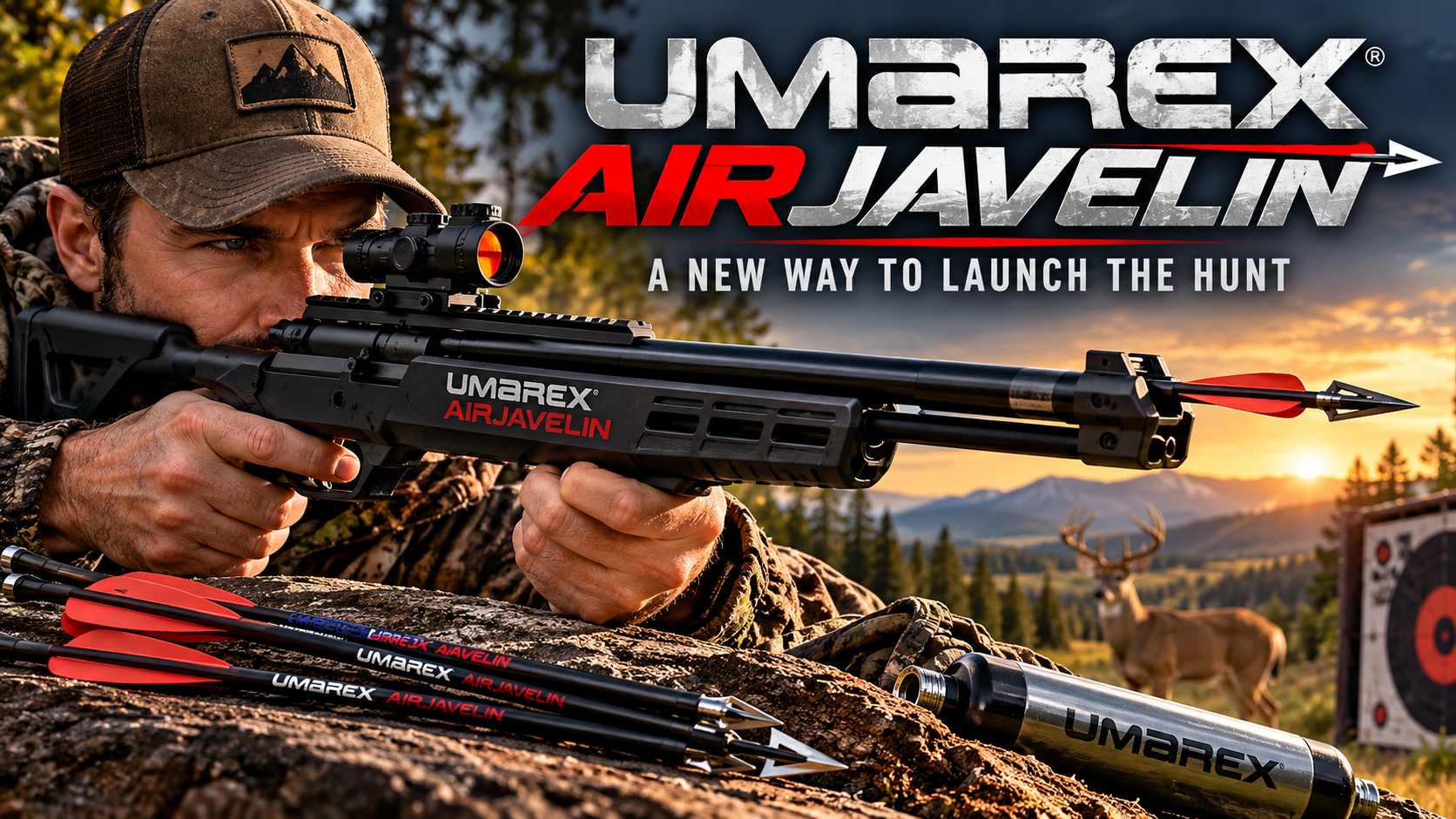
A Hands-On Look at the CO₂-Powered Arrow Launcher That Created a New Kind of Backyard Shooting
Umarex AirJavelin – There is something inherently satisfying about watching an arrow fly toward a target. Traditional archery delivers that experience through stored energy in limbs and a bowstring, while crossbows accomplish essentially the same thing through a compact mechanical platform. The Umarex AirJavelin approaches the problem from an entirely different direction: compressed CO₂.
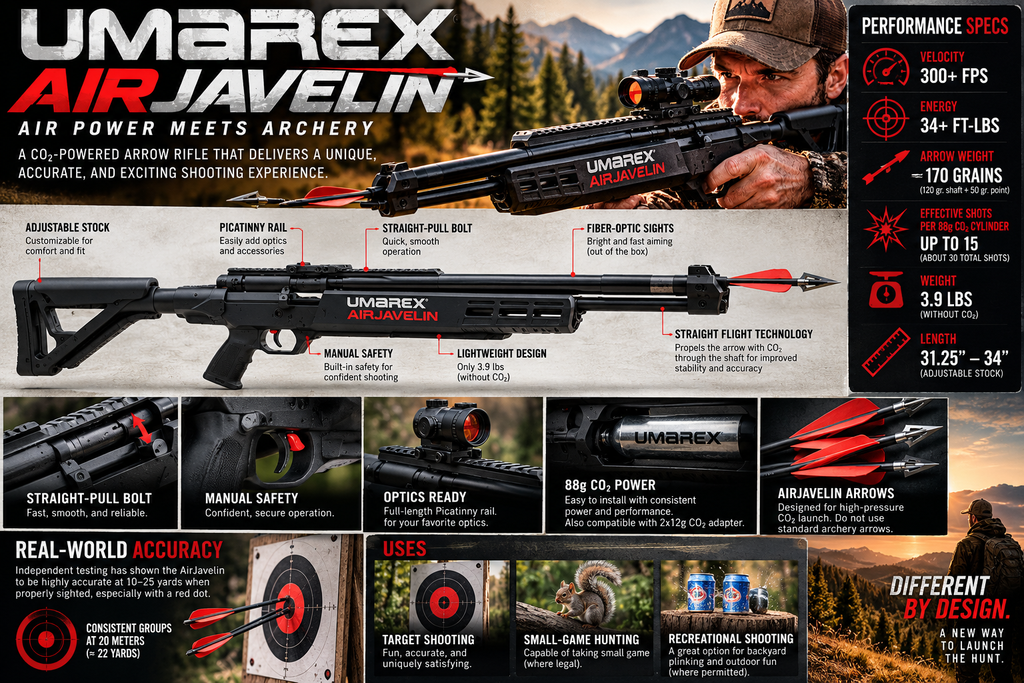
Pull the trigger and an arrow leaves the AirJavelin at a claimed 300-plus feet per second, carrying more than 34 foot-pounds of energy. There is virtually no conventional firearm recoil, no bowstring to draw and none of the physical demands associated with repeatedly pulling a traditional bow. What you get instead is something that feels like an air rifle but sends an arrow downrange.
Umarex introduced the original AirJavelin around 2020 as a lightweight, relatively affordable entry into what has become known as air archery. Unlike the company’s considerably more powerful PCP AirSaber, the AirJavelin was conceived primarily as a recreational and small-game platform rather than a big-game powerhouse. Umarex still describes it as a small-game and recreational CO₂-powered arrow rifle.
For shooters who enjoy airguns, archery and unusual outdoor gear, that’s a pretty interesting combination.
What Exactly Is an AirJavelin?
Calling the AirJavelin an “airbow” makes intuitive sense, although technically it isn’t a bow at all. There are no limbs and there is no string. Instead, an 88-gram CO₂ cylinder supplies the energy needed to propel a specially designed arrow.
The arrow slides over a high-pressure tube rather than simply being pushed from behind. When the trigger is pressed, CO₂ travels through the system and transfers its energy through the arrow assembly. Umarex calls its approach Straight Flight Technology, and the concept is designed to deliver the propulsive force along the arrow’s axis.
The result feels surprisingly rifle-like. There’s an adjustable stock, straight-pull bolt action, manual safety and accessory rails, while the factory sighting system includes a fiber-optic front sight. The current manufacturer listing also describes a full-length Picatinny rail, additional accessory mounting provisions and compatibility with an optional two-12-gram CO₂ adapter.
At just 3.9 pounds without CO₂ and roughly 31¼ to 34 inches long depending upon stock adjustment, it’s considerably easier to handle than many crossbows.
That makes the AirJavelin approachable for new shooters while still being unusual enough to interest experienced airgunners.
Umarex AirJavelin Specifications
The numbers explain much of its appeal. Umarex rates the original AirJavelin at 300+ fps and 34+ foot-pounds of energy. The supplied carbon-fiber arrow shaft weighs approximately 120 grains and comes with a 50-grain field point, putting the basic projectile in roughly the 170-grain neighborhood. The manufacturer currently lists up to approximately 15 effective small-game shots and as many as 30 total shots from an 88-gram CO₂ capsule, although another current Umarex product listing cites approximately 20 shots. Real-world shot count will naturally vary with temperature and shooting conditions because CO₂ performance is temperature-sensitive.
Those figures put the AirJavelin into an interesting performance category. It’s substantially different from an ordinary pellet rifle but shouldn’t be confused with Umarex’s considerably more powerful PCP air-archery systems. The newer AirJavelin Pro, for example, uses pre-charged pneumatic power rather than disposable CO₂ and is rated at 370 fps with a 170-grain arrow and approximately 52 foot-pounds.
Think of the original AirJavelin as the lighter, simpler recreational member of the family.
How Accurate Is the AirJavelin?
Velocity numbers make good advertising copy, but accuracy determines whether a shooting platform is actually enjoyable.
This is where independent testing becomes useful.
Veteran airgun writer Tom Gaylord extensively tested the AirJavelin for Pyramyd AIR. After fitting a red-dot sight and working through the sighting process, he tested the platform at both 10 and 20 meters. His experience supported what he had previously observed on Umarex’s SHOT Show range at roughly 25 yards: properly set up, the AirJavelin was capable of keeping arrows impressively close together.
That doesn’t mean the AirJavelin should be treated like a centerfire rifle. Arrows have very different external ballistics, and trajectory becomes increasingly important as distance increases. The useful lesson is that the platform is capable of considerably more precision than its almost toy-like weight initially suggests.
For recreational shooting, I’d view short-to-moderate distances as the AirJavelin’s natural habitat. A good red dot can make it particularly enjoyable because the virtually recoil-free firing cycle makes target acquisition easy.
There is also something undeniably entertaining about watching the arrow’s flight in a way that simply isn’t possible with a high-velocity rifle bullet.
A Natural Backyard Target Shooter—Where Lawful
Perhaps the AirJavelin’s greatest strength isn’t hunting at all.
It’s fun.
Set up an appropriate archery target with a safe backstop, observe all applicable local discharge rules, and the AirJavelin provides a completely different shooting experience from a pellet gun, bow or crossbow.
There is very little recoil, the adjustable stock makes it adaptable to different shooters, and the controls will immediately feel familiar to anyone who has handled a modern sporting rifle or airgun.
That combination also makes it an interesting gateway into shooting sports for people who may struggle with drawing a conventional bow.
But don’t confuse accessibility with harmlessness. At roughly 300 fps, this is a serious projectile launcher requiring the same disciplined muzzle awareness, target identification and backstop considerations you’d apply to other shooting equipment.
Umarex AirJavelin Safety and Air-Archery Guidance
What About Small-Game Hunting?
Umarex specifically markets the original AirJavelin for small-game hunting and recreation, and its arrows can accept compatible screw-in points, including appropriate broadheads.
That does not, however, mean you should automatically take one hunting.
Air-powered arrow launchers occupy an unusual legal category. Depending on where you live, regulators may classify them as airguns, arrow guns, airbows or something else entirely. They may be permitted for one species but prohibited for another, or legal during a general season while excluded from an archery-only season.
Umarex itself now emphasizes this point in its hunting guidance: equipment capability does not establish legal permission. Hunters need to verify the exact platform, projectile, species, season and land regulations with their state wildlife agency before hunting.
That’s especially important because regulations continue to evolve as air archery becomes more popular.
Current Umarex Air-Archery Hunting Law Guide
If hunting is the goal, I’d also resist the temptation to treat the manufacturer’s maximum velocity as an indication of ethical maximum range. Accuracy, retained energy, projectile choice, legal requirements and the shooter’s ability to place the arrow consistently all matter.
One Safety Rule You Absolutely Cannot Ignore
Here’s perhaps the most important piece of information in this entire review:
Do not load ordinary bow or crossbow arrows into the AirJavelin.
Umarex explicitly warns that only arrows designed for the AirJavelin should be used. Conventional archery arrows aren’t engineered to contain the pressure generated inside this system and can fail catastrophically, potentially causing serious injury to the shooter or bystanders.
This isn’t an accessory recommendation designed to sell proprietary arrows. It’s a fundamental s