Because being a capable man requires more than knowing your Wi-Fi password and how to operate a grill
Five Essential Life Skills – There comes a point in every man’s life when he realizes nobody is coming to hand him the instruction manual. Maybe it happens when the toilet starts overflowing at 11:30 on a Sunday night, when your car begins making a noise that sounds like two skeletons fighting inside a washing machine, or when somebody asks what you think about compound interest and you suddenly become extremely interested in something happening across the room. Eventually, life presents you with a problem and waits to see what you’re going to do about it.
Being a capable man doesn’t mean conforming to some exaggerated version of masculinity. You don’t need to rebuild a transmission, wrestle a bear, smoke your own brisket, build a cabin with an axe, and quote Marcus Aurelius before breakfast. But there is something deeply satisfying about knowing you can handle yourself when ordinary life throws problems your way. Competence creates confidence, and the more problems you can solve without panicking, outsourcing your entire existence, or calling your father, the more independent you become.
The skills that matter most aren’t necessarily impressive. They’re the everyday abilities that save money, strengthen relationships, make life easier, and allow you to remain useful when everyone else is wondering what to do next. Here are five every man should work toward mastering.
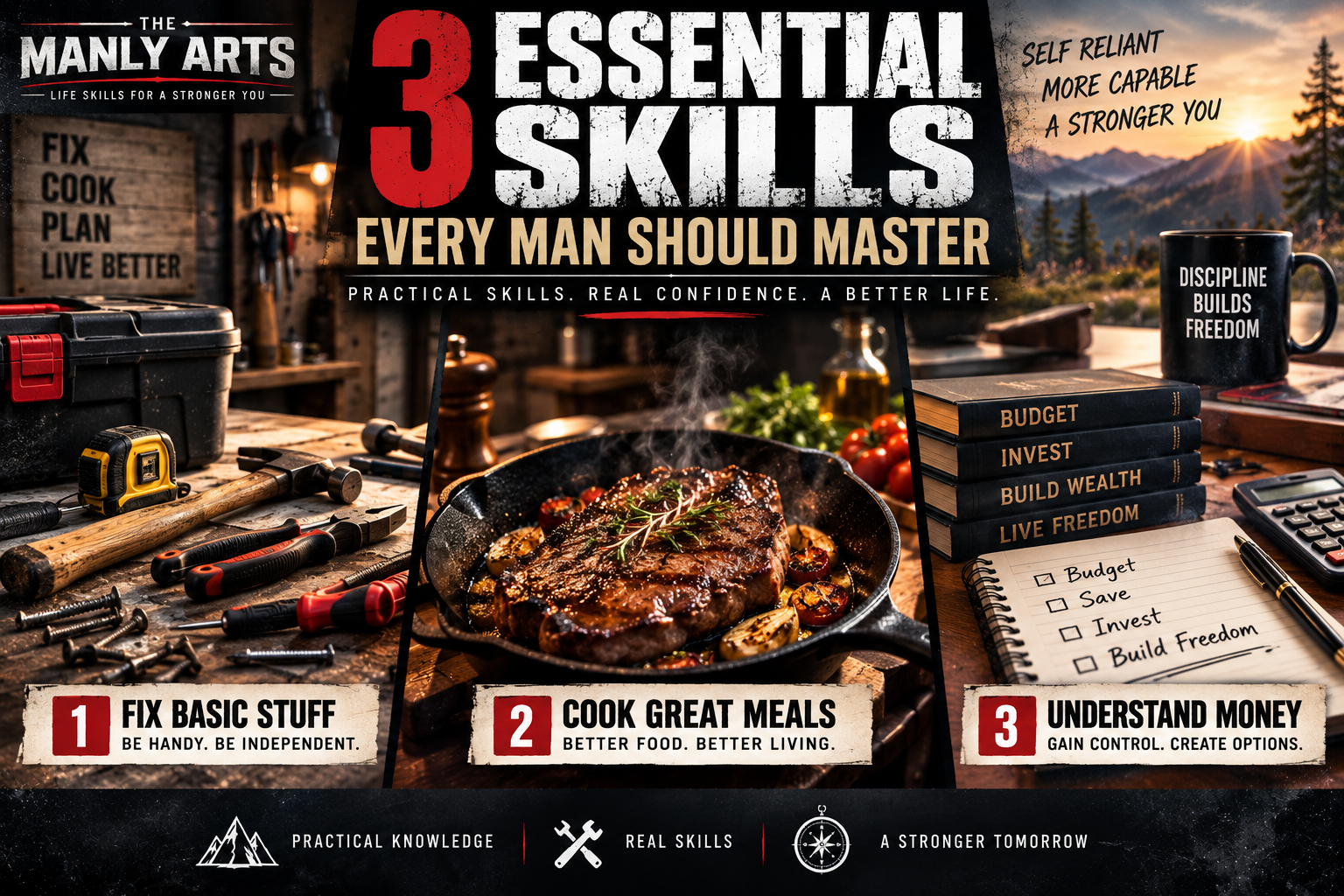
1. Learn How to Fix Basic Stuff
Every house eventually decides to challenge the authority of the person paying the mortgage. A faucet begins dripping at three in the morning. A toilet refuses to stop running. A cabinet door suddenly hangs at an angle suggesting it has lost the will to live. You stand there looking at it, it seems to look back at you, and a small test of adulthood begins.
Being handy doesn’t mean you need to renovate a bathroom over the weekend or construct patio furniture from trees you personally harvested. It simply means developing enough mechanical confidence to investigate ordinary problems before immediately reaching for your phone and credit card. Start by assembling a respectable basic toolkit: hammer, adjustable wrench, pliers, screwdriver set, tape measure, level, utility knife, stud finder, socket set and cordless drill. Then actually learn how to use them. Knowing the difference between Phillips, flathead, Torx and hex fasteners will already put you ahead of the guy attempting every household repair with the tiny screwdriver that came with his kid’s toy.
More importantly, learn the fundamentals of your home. Know where the main water shutoff is located, how to reset a circuit breaker, how to unclog a drain, patch a small drywall hole, replace a toilet flapper and safely hang something heavy on a wall. Modern technology has made this easier than ever. A reputable tutorial can walk you through many basic repairs step by step, meaning the internet has essentially provided every man with thousands of extremely patient surrogate dads explaining how to fix a faucet.
Of course, competence also means knowing when you’re outmatched. Major electrical work, gas lines, structural repairs and complicated plumbing are excellent opportunities to embrace the talents of trained professionals. The goal isn’t knowing how to fix everything. It’s developing the mindset that when something breaks, your first reaction is curiosity rather than helplessness: Let’s see if I can figure this out.
2. Learn How to Cook Five Great Meals
At some point, a grown man should graduate from viewing cooking instructions as mysterious ancient texts. “Reduce heat and simmer” shouldn’t send you into an existential crisis about exactly how much heat and what technically constitutes simmering. Cooking is mostly repetition, timing, temperature and learning not to wander away from the stove because somebody sent you a funny video.
You don’t need culinary-school credentials. You need a handful of meals you can confidently prepare without repeatedly checking the recipe like you’re defusing a bomb. Start with five: a great breakfast, a pasta dish, a chicken dish, a steak or grilled entrée, and one signature dinner you’d confidently serve to friends, family or a date. Along the way, learn the fundamentals—how to chop an onion, season meat, roast vegetables, cook rice, prepare eggs and use a meat thermometer. Those simple skills give you enough foundation to improvise rather than living entirely at the mercy of recipes.
Take steak as an example. Season it properly, get the grill or pan hot, cook it intentionally rather than flipping it every twelve seconds, check the internal temperature and let it rest before slicing. You don’t need to stab the thing repeatedly like you’re interrogating it about the location of stolen diamonds. Learn the process, repeat it a few times and eventually you have a meal you can prepare almost automatically.
Cooking for yourself is useful; being able to cook for other people is something more. There’s a quiet confidence in telling friends, “Come over. I’ll make dinner.” Food creates connection, and a man who knows how to put a genuinely good meal on the table possesses a skill that will serve him throughout his life. Even if your signature meal is spaghetti Bolognese, make it your spaghetti Bolognese. Every man deserves at least one dish people specifically request.
3. Learn How Money Actually Works
Nothing destroys the illusion of adulthood faster than realizing you’ve been working for fifteen years and still aren’t entirely sure where your money goes. Somehow you received a paycheck, paid several bills, bought lunch a few times, ordered something unnecessary online, and now your bank account looks like it has been burglarized.
Financial literacy isn’t particularly glamorous. Nobody has ever leaned across a bar and whispered seductively, “Tell me more about your diversified retirement portfolio.” But understanding money provides something considerably more valuable than glamour: options. Money gives you the ability to leave a terrible job, survive an emergency, help someone you love, start a business, travel, retire with dignity or simply sleep without wondering whether an unexpected car repair is going to wreck the month.
Start by knowing exactly what comes in and what goes out. Build an emergency fund, attack high-interest consumer debt, understand how credit works and begin investing consistently for retirement. Learn the basic concepts of compound interest, index funds, retirement accounts, insurance and taxes. You don’t need to become Warren Buffett; you simply need to stop treating your financial future as something Future You will magically figure out.
That’s particularly important because Future You is going to have expenses too. Cars break, roofs leak, children appear, medical bills happen and somebody will inevitably invent another television that seems vastly superior to the perfectly functional television currently hanging on your wall. Automating savings and investments allows you to pay your future self before your present self discovers another expensive hobby.
Financial discipline doesn’t mean becoming miserly or refusing to enjoy your money. Buy the motorcycle, take the vacation or acquire the absurdly elaborate backyard grill if those things genuinely improve your life. Just make sure you can actually afford your ridiculous things. The goal isn’t dying with the largest bank account; it’s preventing money from controlling every decision you make while you’re alive.
4. Learn How to Communicate When Things Get Uncomfortable
Most of us communicate beautifully when everybody agrees with us. The real test arrives when we’re angry, embarrassed, disappointed, criticized, rejected or absolutely convinced the other person has temporarily lost his or her mind. That’s when communication tends to deteriorate into sarcasm, shouting, silence or the classic male conflict-resolution technique of disappearing into the garage and reorganizing tools until everyone forgets what the argument was about.
Good communication requires more courage than many physical confrontations because you can’t hide behind strength. You have to say what you actually mean, listen to something you might not enjoy hearing and accept that being right isn’t always the same thing as solving the problem. Start by learning to listen without mentally constructing your rebuttal while the other person is still talking. Ask questions before assigning motives, explain specifically what’s bothering you instead of expecting someone to decode your mood, and criticize behavior rather than attacking someone’s character.
Learning how to apologize properly is equally important. “I’m sorry you got upset” is not an apology; it’s an accusation wearing a fake mustache. A meaningful apology acknowledges what you did, accepts responsibility and explains what you’re going to do differently. Likewise, if you’re too angry to communicate productively, stepping away temporarily can be mature. Tell the other person you need time to cool down and, importantly, come back to the conversation. Walking away for thirty minutes is emotional regulation. Walking away from every difficult conversation is avoidance wearing work boots.
Whether you’re dealing with your wife, girlfriend, children, parents, friends, coworkers or boss, being able to calmly say, “Here’s what I’m thinking, here’s what I’m feeling, and I want to understand your side,” will solve more problems than being the loudest man in the room. Real confidence doesn’t require winning every argument. Sometimes it requires caring more about the relationship than the scoreboard.
5. Learn How to Stay Calm When Everything Goes Sideways
The smoke alarm starts screaming. Someone gets hurt. Your flight is canceled. The car won’t start. The power goes out. Your kid is staring at you. Everyone else is asking what to do. These are the moments when capability becomes leadership, and leadership doesn’t necessarily mean having all the answers. Often it simply means remaining calm enough to find the next one.
Men sometimes confuse courage with the absence of fear, but courage is functioning effectively while your nervous system is loudly announcing that the current situation appears less than ideal. That’s a skill you can develop. Learn basic first aid and CPR. Keep sensible emergency supplies at home and in your vehicle. Maintain situational awareness when you’re somewhere unfamiliar. Exercise regularly so your body becomes accustomed to functioning under physical stress, and practice controlling your breathing when adrenaline spikes.
Most importantly, learn to simplify problems. When everything seems to be going wrong, ask three questions: What is the immediate problem? What can I control? What is the next useful action? You don’t need to solve the next twenty steps while standing in the wreckage of step one. You need to handle what comes next.
Martial artists understand this principle well. When you’re trapped underneath a skilled opponent, panic doesn’t improve the situation. It burns energy, clouds judgment and usually makes things worse. You breathe, protect yourself, establish position, identify the immediate problem and begin working toward something better. Life operates much the same way. Sometimes adulthood feels like one long series of unexpected problems interrupted by lunch, but the ability to remain useful when circumstances deteriorate is one of the most valuable forms of confidence a man can develop.

Becoming the Man People Can Count On
Nobody completely masters adulthood. The guy who can rebuild your dishwasher might destroy a Thanksgiving turkey. The financial wizard may have absolutely no idea how to change a tire. The martial arts black belt capable of remaining perfectly calm while another human tries to choke him unconscious might still spend twenty minutes searching the house for glasses currently sitting on top of his head. We’re all unfinished projects.
That’s precisely the point. Becoming a capable man isn’t about proving you’re tougher, smarter or more masculine than somebody else. It’s about continually expanding the number of situations you can handle with confidence, judgment and enough humor to keep yourself sane. Learn how to fix something. Cook something worth eating. Understand where your money goes. Have the difficult conversation. Stay calm when the plan falls apart. Then pick another skill and start learning that one too.
The goal isn’t becoming a man who never needs anyone. That’s neither realistic nor particularly desirable. The goal is becoming the kind of man who can take care of himself, contribute when things get difficult and help the people around him when they need it.
In other words, become the man people know they can count on.