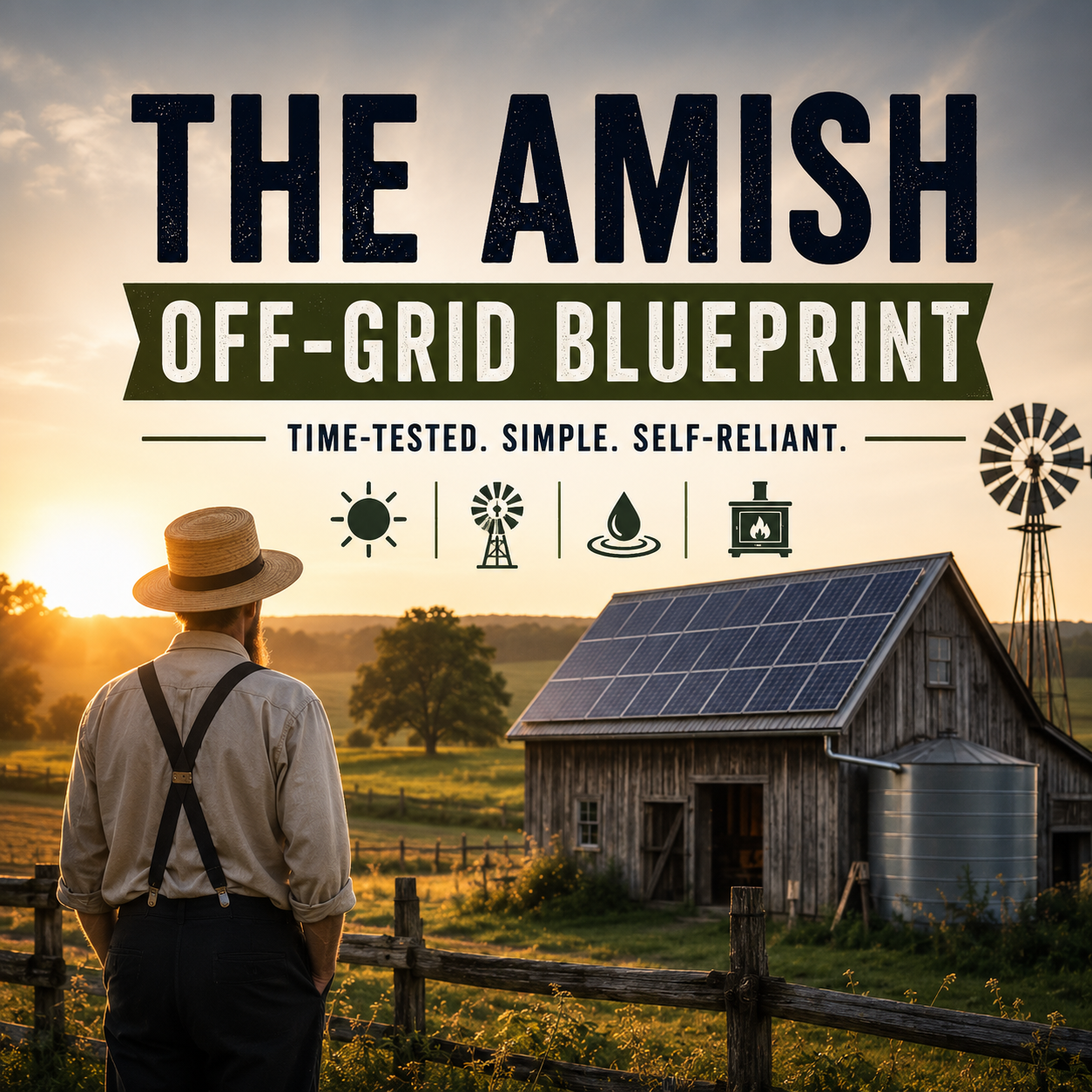
Time-Tested Alternative Energy for the Modern Home
Discover how 300 years of Amish off-grid wisdom can cut your bills and boost your family’s resilience
The Amish Off-Grid Blueprint – The last major power outage likely left you scrambling for flashlights with dying batteries while your phone’s charge ticked toward zero. Meanwhile, in Amish communities across Pennsylvania, Ohio, and Indiana, families barely noticed the grid going down. They’ve been perfecting off-grid living for nearly three centuries—not as a survivalist hobby, but as a daily reality .
Here’s what might surprise you: The Amish aren’t anti-technology. They’re selective about technology . And their approach to alternative energy offers a practical, proven blueprint for any modern homeowner looking to cut utility costs, gain energy independence, and build real resilience.
Let’s explore how the Amish power their lives—and how you can adapt their wisdom for your own home.
The Philosophy: Mastering Technology, Not Becoming Its Slave
Many outsiders mistakenly believe the Amish reject all modern technology. The truth is more nuanced—and far more instructive. The Amish don’t oppose electricity itself; they oppose being dependent on the public power grid .
Why? Because grid-tied electricity connects them too closely to the outside world, threatening their self-reliance and community cohesion . As the Elizabethtown College Amish Studies program explains, “The Amish seek to master technology rather than become its slave” .
This principle—use what serves you, reject what controls you—is the foundation of their energy approach. And it’s exactly the mindset modern homeowners need when considering alternative power.
Alternative Power Sources the Amish Actually Use

1. Solar Power: The Amish Energy Frontier
Drive through Amish country in northern Indiana, and you’ll notice something unexpected: solar panels on barn roofs, house roofs, and freestanding in yards . These aren’t makeshift installations either—they’re properly mounted, fully functional systems.
According to NPR reporting cited by Farm Progress, approximately 80% of Amish families in Holmes County, Ohio—a major Amish settlement—now use solar panel technology . One enterprising Amish man even sells solar panels to his neighbors.
Why solar works for the Amish:
- Solar generates electricity without grid connection
- Panels charge batteries for off-grid use
- Systems power essential appliances, lights, and tools
- Solar is safer and more efficient than kerosene lanterns
For your home: Residential solar systems with battery storage can achieve the same independence. The technology has matured dramatically—modern panels are more efficient and affordable than ever.
2. Wind Power: Mechanical Water Pumping
The Amish don’t just use wind for electricity—they use it for direct mechanical work, particularly water pumping. Mother Earth News documents an Amish-built 30-foot windmill that pumps water from a 110-foot deep well, filling tanks for livestock without a single watt of grid electricity .
How it works:
- Wind turns the blades, which drive a mechanical pump
- No electricity conversion means less energy loss
- A simple lever engages the system when water is needed
- A hand pump provides backup on windless days
For your home: While modern homeowners typically use wind turbines for electricity generation, the principle remains sound. Small-scale wind systems can supplement solar power, especially in regions with consistent wind patterns.
3. Micro-Hydropower and Mechanical Systems
One SurvivalBlog contributor documented his Amish neighbor’s ingenious water system: a 5-horsepower engine mounted on steel pipe drives a belt connected to a line-shaft system in the basement. This single power source runs both a centrifugal water pump and a wringer washing machine .
The setup:
- Engine powers a 12-foot rotating shaft
- Shaft runs multiple devices simultaneously
- Water pumps to a 500-gallon tank in the barn
- Gravity feeds water back to the house
For your home: While most suburban homes can’t replicate this exact system, the principle of centralized mechanical power is worth considering. Compressed air systems, stationary bicycles converted to generators, or even hand pumps for wells provide backup options when the grid fails.
4. Wood-Burning Systems for Heat and Cooking
Wood-burning stoves remain a cornerstone of Amish energy independence, providing both heating and cooking redundancy . The Amish neighbor mentioned earlier removed an outdoor wood furnace and installed indoor wood stoves for heating and hot water .
Why wood works:
- Renewable fuel you can stockpile indefinitely
- Functions regardless of natural gas or electrical infrastructure
- Provides cooking capability during outages
- Harvesting and seasoning firewood creates energy awareness
For your home: Modern wood stoves and pellet stoves are far cleaner and more efficient than their predecessors. Even a small wood stove provides critical redundancy for winter heating.
The Amish “Hybrid” Approach: Access Without Ownership
One of the most clever Amish innovations is their distinction between access and ownership . When building his neighbor’s front porch, the Amish craftsman used cordless power tools—but at home, he relies on a hand-powered brace and bit .
The principle applies to energy, too:
- Use grid electricity when necessary, but don’t depend on it
- Maintain backup systems for critical functions
- Rent or borrow specialized equipment rather than owning everything
For your home: This translates to a hybrid energy system—grid-tied solar with battery backup, propane appliances alongside electric ones, and manual tools stored for emergencies.
Practical Integration for Modern Homes: Actionable Strategies
Start with an Energy Audit
Before investing in alternative power, understand where your energy goes. The most cost-effective “alternative energy” is the energy you don’t use.
Action steps:
- Identify your must-have loads (refrigeration, medical devices, heating)
- Measure your baseline consumption with a home energy monitor
- Reduce phantom loads and upgrade inefficient appliances
Build a Tiered Backup System
Tier 1 (Immediate, under $500):
- Portable power station (1,000-2,000Wh capacity)
- Small solar panel for recharging
- Propane camp stove for cooking
- Oil lamps or LED lanterns for lighting
Tier 2 (Moderate, $1,000-$5,000):
- Larger battery system with 5-10kWh capacity
- 1,000-2,000W solar array
- Manual water pump or well bucket
- Wood stove or propane heater
Tier 3 (Comprehensive, $10,000+):
- Whole-home battery backup (20kWh+)
- 5-10kW solar array
- Backup generator (propane or diesel)
- Integrated energy management system
Adopt Amish-Inspired Manual Systems
You don’t need to go full Amish to benefit from their wisdom. Consider these low-tech additions:
- Hand-crank grain mill – Fresh flour when the power’s out
- Root cellar or cool storage – Months of food preservation without refrigeration
- Manual laundry wringer – Clothes cleaning without electricity
- Kerosene or propane lamps – Light when batteries die
Professional Resources for Implementation
- Lehman’s Hardware (Kidron, Ohio) – A 65-year-old store specializing in non-electric appliances and tools, originally serving the Amish
- U.S. Department of Energy – Solar energy basics and installation guides
- North American Board of Certified Energy Practitioners – Find certified solar installers
Economic and Environmental Benefits
| Benefit | Impact |
|---|---|
| Utility savings | Solar typically pays for itself in 5-10 years |
| Energy independence | No more vulnerability to rate hikes or outages |
| Increased home value | Solar installations add 4-6% to resale value |
| Tax incentives | Federal solar tax credit (30% through 2032) |
| Environmental | Reduced carbon footprint without sacrificing comfort |
The Resilience Factor: Why This Matters Now
The Amish don’t prep for hypothetical doomsdays—they live this way every day. Their systems have been tested by actual grid failures, supply disruptions, and extreme weather. When modern infrastructure fails, they don’t panic. They light a lamp, stoke the wood stove, and go about their evening .
That’s not paranoia. That’s practicality.
As the Farm Progress editorial noted after touring Amish country: “If you give up nothing to generate electricity, as the Amish do, what have you lost? Nothing” .
Conclusion: Bringing It Home
You don’t need to sell your car or trade your smartphone for a buggy to benefit from Amish energy wisdom. The core lesson is this: selective adoption of technology, coupled with redundant systems, creates genuine resilience.
Start small. Buy a hand-crank grain mill or a quality oil lamp. Install a few solar panels and a small battery. Add a wood stove or propane backup. Each step moves you toward the same freedom the Amish have enjoyed for 300 years—the freedom to live well, regardless of what the grid does.
The question isn’t whether you can afford to prepare. It’s whether you can afford not to.
Additional Resources
- Lehman’s Hardware – Non-electric tools and appliances – www.lehmans.com
- U.S. Department of Energy Solar Guide – energy.gov/eere/solar
- Mother Earth News – Practical homesteading and renewable energy – www.motherearthnews.com
- Amish Studies at Elizabethtown College – Research on Amish technology use – groups.etown.edu/amishstudies
Have you implemented any off-grid systems in your home? Share your experience in the comments below.