
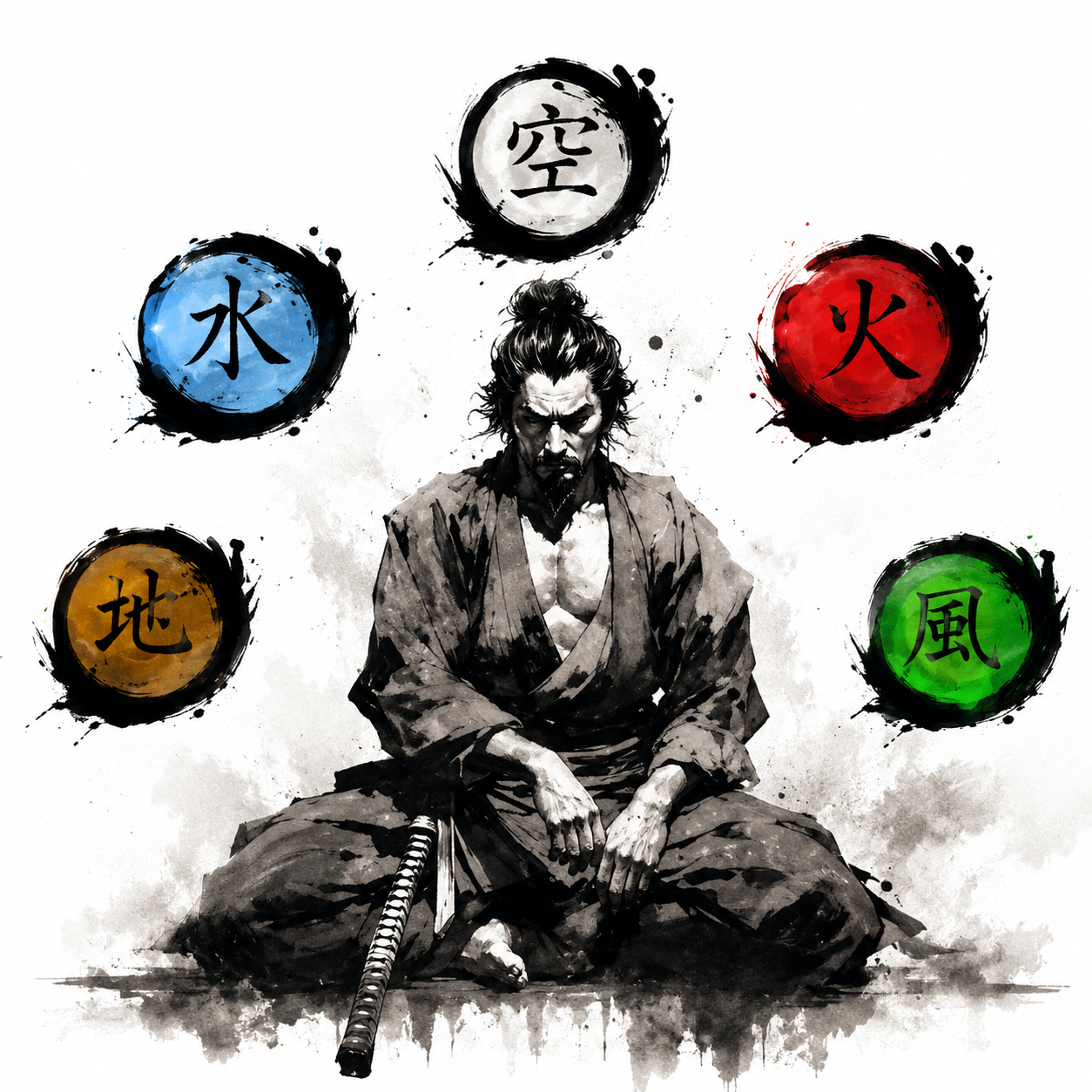
Musashi’s Book of Five Rings for Modern Life
Musashi and the Way of the Warrior – How a 17th-century samurai’s masterpiece can sharpen your focus, destroy distraction, and forge unshakable discipline
You wake up to 47 unread emails. Your calendar is a war zone of back-to-back meetings. By noon, you’ve already lost three battles—to procrastination, to pointless Slack notifications, and to the nagging feeling that you’re busy but not effective.
Now imagine facing actual swords. No second chances. No “I’ll get to it tomorrow.”
That was Miyamoto Musashi’s reality. The greatest ronin (masterless samurai) in Japanese history, Musashi fought over 60 duels—and never lost. Near the end of his life, he retreated to a cave called Reigandō and wrote “The Book of Five Rings” (Go Rin No Sho) , a manual not just for sword fighting, but for strategy, mindset, and mastery.
Most men read it once, nod respectfully, and put it back on the shelf. The men who apply it? They become unstoppable.
Below, I break down each of Musashi’s five rings—Earth, Water, Fire, Wind, and Void—and give you one concrete, modern tip per ring. Use these, and you’ll stop reacting to life and start commanding it.
The Ground Beneath Your Feet: The Book of Earth
What it teaches: Fundamentals. Structure. Knowing your craft so deeply you never have to think about it.
Musashi opens the Earth Book with a deceptively simple line: “Study the strategy of the warrior way.” He’s not talking about exotic techniques. He means: master the basics until they become instinct.
Key passage:
“Do not think dishonestly. The Way is in training.”
— from the “Earth Book” section
Modern application: Most professionals chase hacks, shortcuts, and the “one weird trick.” Musashi would call that cowardice. The real edge is boring mastery.
Concrete tip:
Pick one fundamental skill in your field—writing, coding, selling, leading—and practice it deliberately for 25 minutes every morning before checking email. No phone. No music. Just focused repetition. After 30 days, that skill becomes reflex. After a year, it becomes a weapon.
Example: A lawyer who studies contract law 20 minutes daily doesn’t just know the rules. She feels the loopholes. That’s the Earth Book in action.
The Fluidity of Focus: The Book of Water
What it teaches: Adaptability. Shaping yourself to the situation like water fills a cup.
Musashi compares the mind to water: calm on the surface, capable of raging current below. The enemy of water is rigidity—a fixed stance, a predictable rhythm.
Key passage:
“In strategy, you must adopt the feeling of water. Water adapts to the shape of its container, yet it can wear down stone.”
— from the “Water Book” section
Modern application: How many times have you stuck with a failing plan because “that’s how it’s always been done”? Rigid thinking is a slow death.
Concrete tip:
Practice daily strategic pivoting. Once per day, interrupt your routine with a small but intentional change: take a different route to work, respond to an email in 30 seconds instead of 30 minutes, or swap your afternoon coffee for a five-minute walk. This trains your brain to release attachment to “the way things are supposed to be.”
When a real crisis hits—a layoff, a project failure, a relationship rupture—you won’t freeze. You’ll flow.
Real-world example: During the pandemic, companies that pivoted quickly (restaurants to delivery, gyms to online classes) didn’t just survive. They thrived. That’s the Book of Water.
The Tempo of Victory: The Book of Fire
What it teaches: Aggression, timing, and seizing the moment. Fire isn’t reckless—it’s controlled intensity.
Musashi dedicates this book to combat itself: when to strike, when to feint, and how to read your opponent’s rhythm. He famously wrote about “holding down the pillow”—pinning your enemy so they cannot recover.
Key passage:
“In battle, if you make your opponent flinch even slightly, you have already won.”
— from the “Fire Book” section
Modern application: Most men hesitate. We wait for the perfect moment, the perfect data set, the perfect mood. Fire says: create the moment.
Concrete tip:
Identify your “pillow” in one area of life—that one bottleneck that, if removed, would free everything else. Then attack it first thing tomorrow morning, before your brain talks you out of it.
Examples:
- At work: That one difficult client conversation you’ve been avoiding? Do it in the first hour.
- In fitness: The exercise you hate most? Do it first.
- At home: The garage you’ve been ignoring? Spend 15 minutes on it before breakfast.
Musashi knew: hesitation is the seed of defeat. Fire burns hesitation alive.
The Art of Unconventional Thinking: The Book of Wind
What it teaches: Knowing other schools. Understanding what your competitors do so you can counter them—or ignore them entirely.
This is the shortest book in the Five Rings, and deliberately so. Musashi says: “To know the ways of other traditions is to see their weaknesses.”
Key passage:
“Some traditions rely on flashy techniques. Others rely on speed alone. Neither understands the true Way.”
— from the “Wind Book” section
Modern application: You don’t need to master everything. But you do need to know what your rivals, colleagues, or even your own past self are doing wrong—so you can avoid those traps.
Concrete tip:
Every quarter, conduct a competitive audit of one area of your life:
- Career: What are the top three mistakes people in your field make? (e.g., overpromising, ignoring soft skills, failing to delegate)
- Health: What common fitness or diet fads waste people’s time? (e.g., detox teas, “fat-burning” supplements)
- Finances: What investing mistakes do amateurs repeat? (e.g., panic selling, chasing hot stocks)
Write them down. Then actively don’t do those things. That’s not passive avoidance—that’s strategic intelligence.
Musashi didn’t win 60 duels because he was the strongest. He won because he understood his opponents better than they understood themselves.
The Silence Beyond Thought: The Book of Void
What it teaches: The unteachable. The place where strategy becomes instinct, and action flows without conscious effort.
The Void Book is the most mysterious—and the most powerful. Musashi describes a state of “no-mind” (mushin), where the warrior acts without fear, doubt, or hesitation. It’s not emptiness. It’s everything without attachment.
Key passage:
“The void is the place where nothing is concealed. To know the void is to know the Way.”
— from the “Void Book” section
Modern application: You’ve felt this. When you’re “in the zone”—playing a sport, giving a presentation, even having a difficult conversation—and the words or actions just arrive perfectly. That’s the Void.
Concrete tip:
You cannot force the Void. But you can invite it. Try this daily “no-mind reset” :
- Sit somewhere quiet for 5 minutes.
- Pick a single anchor (your breath, a candle flame, or a single word like “still”).
- When thoughts arise—and they will—don’t fight them. Just watch them pass like clouds.
- No judgment. No goal. Just presence.
Do this every morning. Over time, that stillness seeps into the rest of your day. You’ll notice yourself responding instead of reacting. You’ll make better decisions because the noise—the fear, the ego, the “what ifs”—has quieted.
That’s not meditation fluff. That’s Samurai discipline applied to a modern nervous system.
Conclusion: The Warrior’s Path Starts With One Step
You don’t need a katana. You don’t need to quit your job and move to a mountain cave. You just need to start acting like a warrior in the small, forgotten moments of your day.
Your 7-day challenge:
- Day 1 (Earth): Identify one fundamental skill you’ve been neglecting. Practice it for 20 minutes.
- Day 2 (Water): Change one small routine. Notice how it feels.
- Day 3 (Fire): Attack your most avoided task before 10 AM.
- Day 4 (Wind): Write down three mistakes your competitors make. Vow to avoid them.
- Day 5 (Void): Sit in stillness for 5 minutes. No phone, no agenda.
- Day 6 & 7: Repeat any of the above. Then choose one to build into a daily habit.
The Miyamoto Musashi Book of Five Rings isn’t ancient history. It’s a mirror. Look closely, and you’ll see a warrior waiting to be unleashed—not against other men, but against the chaos, distraction, and mediocrity that steal your days.
As Musashi wrote in his final days: “Respect the gods and Buddhas, but do not depend on them. The Way is within you.”
Now go train.
Further Resources
- Musashi Wikipedia – Explore historical artifacts, original manuscripts, and scholarly research on Musashi’s life and legacy.
- Modern Bushido – Practical deep-dives on applying samurai wisdom to work, relationships, and discipline.
- The Book of Five Rings Online– Read the full text yourself, free of charge.
Which of the five rings resonates most with your current struggles? Drop a comment below. I read every one.




This is really interesting, You’re a very good blogger. I’ve joined your feed and look forward to seeking more of your magnificent post. Also, I’ve shared your site in my social networks!
Great article thank you.