
Ancient Lessons in Strength, Discipline, Faith, and the Art of Living with Purpose
What Can a Roman Emperor Teach a Christian Man About Life?
Stoic Wisdom for the Christian Man – Imagine waking up every morning knowing that the world is going to test your patience, challenge your beliefs, threaten your peace, and occasionally make you question the intelligence of the entire human race. Your boss is unreasonable, the bills keep coming, social media has turned disagreement into a competitive sport, and somewhere along the way, being a good man has become considerably more complicated than simply doing the right thing.
Now imagine having a philosophy that prepares you for those challenges before they even arrive.
Nearly two thousand years ago, a Roman emperor named Marcus Aurelius wrestled with many of the same fundamental problems confronting men today: responsibility, temptation, disappointment, mortality, difficult people, and the struggle to maintain personal integrity in a world that rarely rewards it consistently. His private reflections, eventually published as Meditations, became one of history’s most influential works on self-discipline and personal character.
Marcus Aurelius was a Stoic philosopher, not a Christian. Yet many of his observations about courage, humility, perseverance, and controlling one’s reactions sound remarkably familiar to anyone who has spent time reading Proverbs, the letters of Paul, or the teachings of Jesus Christ.
This raises an interesting question: Can a Christian man embrace Stoic wisdom without compromising his faith?
The answer is yes, provided we understand an important distinction. Stoicism offers practical tools for developing character and emotional discipline, while Christianity provides a theological foundation rooted in God’s grace, the teachings of Christ, and the promise of eternal life. The two philosophies are not interchangeable, and their differences matter. Nevertheless, when examined through a biblical lens, many Stoic principles can reinforce the virtues that Christian men are already called to cultivate.
For the modern man attempting to balance faith, family, work, leadership, and personal growth, the intersection of Christianity and Stoicism offers an opportunity to rediscover something our culture desperately needs: strength without arrogance, discipline without cruelty, courage without recklessness, and peace without surrender.
1. Control What You Can, Trust God with What You Cannot
One of the foundational teachings of Stoicism comes from the philosopher Epictetus, a former slave who became one of the ancient world’s most influential teachers. In his Enchiridion, he opens with a deceptively simple observation:
“Some things are in our control and others not.” — Epictetus, Enchiridion, Chapter 1, translated by Elizabeth Carter
That single principle can transform how a man approaches nearly every challenge in life. We cannot control the economy, the weather, other people’s opinions, or whether someone decides to cut us off in traffic. We can, however, influence our choices, preparation, behavior, effort, and response to adversity. Much of life’s unnecessary frustration comes from exhausting ourselves trying to control things that were never ours to command.
Christianity offers a complementary perspective, but with an important difference: believers are called not merely to accept what lies beyond their control, but to entrust those circumstances to God.
In Proverbs 3:5–6, Scripture teaches:
“Trust in the LORD with all thine heart; and lean not unto thine own understanding. In all thy ways acknowledge him, and he shall direct thy paths.” — KJV
The Stoic seeks peace through disciplined judgment and acceptance of nature’s order. The Christian seeks peace through disciplined action, prayer, and confidence in God’s providence. Both approaches discourage pointless anxiety over uncontrollable circumstances, but Christianity places ultimate trust in a personal God rather than human reason alone.
For men struggling with financial pressure, career uncertainty, family conflict, or unexpected setbacks, this distinction is enormously practical. Do the work you are responsible for doing. Prepare carefully, act honorably, and make the best decisions available with the information you possess. Then recognize that no amount of worrying can guarantee the outcome.
A Christian man should never confuse faith with passivity. Trusting God does not excuse laziness, poor planning, or avoiding difficult responsibilities. It means giving your best effort without allowing the uncertainty of the result to consume your peace.
2. Emotional Discipline: Master Your Anger Before It Masters You
There is a persistent misconception that Stoicism teaches men to become emotionless, detached, and incapable of expressing vulnerability. In reality, classical Stoic philosophy emphasized examining judgments and avoiding destructive passions, not simply pretending emotions do not exist.
This distinction matters because anger, resentment, jealousy, and frustration can become powerful forces in a man’s life. An uncontrolled temper can destroy relationships, undermine leadership, damage careers, and turn minor disagreements into lasting conflicts. Conversely, learning to recognize emotions without automatically obeying them is one of the clearest signs of genuine maturity.
The Bible addresses this issue directly:
“He that is slow to anger is better than the mighty; and he that ruleth his spirit than he that taketh a city.” — Proverbs 16:32, KJV
Consider the significance of that comparison. Scripture places the man who controls his temper above the warrior who conquers a city. In a culture that frequently celebrates physical dominance, aggressive confrontation, and winning at any cost, that is a remarkably powerful definition of strength.
Marcus Aurelius explored a similar idea in Meditations, repeatedly reminding himself that other people’s misconduct did not require him to abandon his own principles. He recognized that responding to foolishness with more foolishness merely multiplied the original problem.
For Christian men, the lesson is not that anger is always wrong. Jesus himself expressed anger at wrongdoing, and Ephesians 4:26 acknowledges that anger can exist without necessarily becoming sin. The challenge is learning to distinguish righteous concern from wounded pride, justified frustration from uncontrolled aggression, and necessary confrontation from personal retaliation.
Imagine a disagreement with your spouse, a disrespectful employee, or a teenager determined to test every boundary in the household. The instinctive reaction may be to raise your voice, assert authority, or demand immediate compliance. The disciplined response is to slow down, identify the real issue, and choose words that address the problem without unnecessarily damaging the relationship.
A man who cannot control his temper is not demonstrating strength. He is demonstrating how easily someone else can control him.
3. Discipline Is the Foundation of Freedom
Modern culture frequently presents freedom as the ability to do whatever feels good whenever the opportunity arises. Eat what you want, buy what you want, avoid uncomfortable responsibilities, and follow every impulse that promises immediate satisfaction. Unfortunately, a life built entirely around gratification often produces the opposite of freedom.
The man who cannot control his spending becomes a prisoner of debt. The man who cannot regulate his appetites becomes dependent on his next indulgence. The man who refuses physical discipline eventually discovers that neglect has consequences. And the man who avoids difficult responsibilities may find his life increasingly controlled by circumstances he could have influenced.
Stoic philosophers understood this relationship between discipline and freedom. Epictetus taught that genuine liberty requires mastery over one’s desires and judgments. Christianity similarly identifies self-control as an essential virtue.
Galatians 5:22–23 describes the fruit of the Spirit, including temperance, commonly translated as self-control. Paul also uses the athletic discipline of ancient competitors to illustrate the Christian life:
“And every man that striveth for the mastery is temperate in all things.” — 1 Corinthians 9:25, KJV
Anyone who has trained seriously in martial arts, wrestling, boxing, or strength and conditioning understands the principle. Progress requires repeatedly doing things that are uncomfortable, inconvenient, and occasionally unpleasant. You train when motivation is absent, correct weaknesses that expose your limitations, and learn to sacrifice immediate comfort for long-term improvement.
Christian self-discipline follows a similar pattern, although its purpose extends beyond personal achievement. Prayer, studying Scripture, serving others, resisting temptation, caring for one’s family, and honoring commitments all require consistent action rather than occasional enthusiasm.
The difference is that Christianity does not teach that discipline alone makes a man righteous before God. Spiritual transformation is ultimately grounded in grace, and discipline becomes a response to that grace rather than a substitute for it.
For the Christian man, self-control is not simply about becoming more productive or physically impressive. It is about developing the character necessary to fulfill his responsibilities faithfully.
4. Courage Is Not the Absence of Fear, but the Willingness to Do What Is Right
Courage is one of the four cardinal virtues of classical Stoicism, alongside wisdom, justice, and temperance. For the Stoics, courage was not simply the willingness to face physical danger. It meant standing firm in one’s principles, enduring hardship without abandoning integrity, and doing what was right even when doing so came at a personal cost. Stanford Encyclopedia of Philosophy
Christianity likewise places tremendous importance on courage, but it connects that virtue to faith in God’s presence and promises. Joshua 1:9 declares:
“Be strong and of a good courage; be not afraid, neither be thou dismayed: for the LORD thy God is with thee whithersoever thou goest.” — KJV
The Christian understanding of courage is particularly relevant to modern masculinity because it challenges the assumption that strength must always be demonstrated through physical confrontation, dominance, or emotional invulnerability. Sometimes courage means standing up for someone being mistreated. Sometimes it means admitting that your marriage needs attention, acknowledging a personal failure, asking for help, or refusing to compromise your values when doing so would be convenient.
Consider the father who works long hours to provide for his family but recognizes that his children need more than financial security. Choosing to be emotionally present, admitting mistakes, and having difficult conversations may require more courage than many of the challenges he encounters professionally. Similarly, a man who refuses to participate in dishonest business practices, even when his career might suffer, demonstrates a form of moral courage that both Stoic philosophy and Christian ethics recognize as valuable.
Courage should never be confused with recklessness. A courageous man evaluates risks, understands his responsibilities, and acts according to his convictions rather than allowing fear or public approval to dictate his decisions.
5. Turn Adversity into an Opportunity for Growth
Few experiences reveal a man’s character more clearly than adversity. Success can disguise weaknesses, while comfort rarely forces us to confront our limitations. Hardship, however, has a remarkable ability to expose what we believe, what we value, and whether our principles survive when circumstances become difficult.
Marcus Aurelius addressed this in Meditations, Book 5, Section 20, explaining that the mind can adapt to obstacles and find ways to continue pursuing its purpose. His reasoning was that resistance need not prevent a person from acting virtuously; sometimes the obstacle itself becomes an opportunity to exercise patience, creativity, or courage.
The Apostle Paul offers a distinctly Christian perspective in Romans 5:3–5:
“Tribulation worketh patience; And patience, experience; and experience, hope.” — Romans 5:3–4, KJV
Paul’s message is not that suffering is inherently desirable or that every painful experience produces growth automatically. Rather, Christian perseverance can develop character and hope through faith in God, even when the reasons for suffering remain unclear.
This distinction is especially meaningful for men facing job loss, divorce, injury, financial hardship, or personal disappointment. A Stoic approach encourages examining what can be learned and what actions remain possible. A Christian approach adds prayer, dependence on God, support from fellow believers, and confidence that suffering does not place a person beyond God’s love.
For example, an athlete who suffers a serious injury may initially view the experience entirely as a setback. With time, rehabilitation can become an opportunity to develop patience, appreciate the body’s limitations, strengthen relationships, and discover aspects of personal identity beyond athletic performance. The injury itself is not necessarily a blessing, but the response to it can produce meaningful growth.
The challenge for Christian men is to resist two equally destructive tendencies: allowing hardship to define their identity or pretending that genuine suffering should never affect them emotionally. Faith and resilience are not measured by how successfully a man hides his pain. They are demonstrated by his willingness to persevere, seek appropriate support, and remain committed to his values through difficult circumstances.
6. Humility: The Virtue That Separates Strength from Arrogance
Modern culture often rewards self-promotion, status, wealth, and the appearance of superiority. Social media has amplified this tendency by creating an environment where success is measured through followers, possessions, physical appearance, and carefully curated lifestyles. Against this backdrop, both Stoic philosophy and Christianity offer a refreshing reminder that character matters more than applause.
Marcus Aurelius occupied one of the most powerful positions in the ancient world, yet his private writings repeatedly emphasized the temporary nature of fame, wealth, and political influence. He recognized that public recognition was fleeting and that personal integrity should not depend upon the opinions of others.
Christianity goes further by identifying humility as central to the example of Jesus Christ. Philippians 2:3 teaches:
“Let nothing be done through strife or vainglory; but in lowliness of mind let each esteem other better than themselves.” — KJV
Humility does not require men to abandon ambition, confidence, or leadership. It requires understanding that personal achievement does not make someone inherently more valuable than another person. A successful businessman can remain humble while building a company. A martial arts instructor can be confident in his abilities without humiliating beginners. A father can exercise authority while acknowledging when his children have taught him something important.
For Christian men, humility also means recognizing that talents, opportunities, and accomplishments carry responsibilities. The question becomes less about how much recognition we receive and more about how effectively we use our abilities to serve others.
This is where Christian leadership offers something particularly valuable. Rather than treating authority as permission to dominate, Jesus presents leadership through service, most memorably when he washes his disciples’ feet in John 13.
The strongest leader is not necessarily the man who demands the most respect. Often, he is the man whose character makes respect a natural response.
7. Remember Your Mortality and Live with Purpose
One of the most recognizable concepts in Stoic philosophy is memento mori, a Latin phrase meaning “remember that you must die.” Although the expression is commonly associated with Stoic practice, reflection on mortality appears throughout ancient philosophy and Christian tradition.
At first glance, deliberately contemplating death might seem unnecessarily grim. Yet the purpose is not to cultivate fear or pessimism. It is to recognize that time is finite and therefore valuable.
Marcus Aurelius frequently reminded himself of life’s brevity, questioning the wisdom of wasting precious time on resentment, vanity, or trivial disputes. Christianity echoes this concern in Psalm 90:12:
“So teach us to number our days, that we may apply our hearts unto wisdom.” — KJV
For a Christian man, contemplating mortality should not produce hopelessness. Rather, it should encourage intentional living, spiritual preparation, and a clearer understanding of what truly matters.
Think about how easily ordinary life becomes consumed by distractions. Hours disappear into social media, arguments about politics, professional frustrations, and endless pursuits of possessions that provide temporary satisfaction. Meanwhile, children grow older, parents age, friendships fade through neglect, and opportunities to serve others quietly pass.
The Stoic asks whether his actions reflect a life guided by virtue. The Christian asks whether his life reflects love for God and neighbor, and whether he is faithfully using the time entrusted to him.
Both questions challenge men to reconsider their priorities. The goal is not to abandon ambition or stop enjoying life. It is to recognize that professional success means little if it comes at the expense of every relationship that gives life meaning.
A man who remembers that his days are numbered may become more patient with his children, more attentive to his marriage, more willing to forgive, and less concerned about impressing people whose opinions ultimately have little significance.
8. Where Stoicism and Christianity Fundamentally Differ
Although Stoicism and Christianity share several ethical principles, it would be inaccurate to suggest that they teach the same worldview. Understanding their differences is essential for Christian men who want to benefit from Stoic philosophy without confusing it with biblical teaching.
Classical Stoicism generally understood the universe as an ordered, rational whole governed by divine reason, often called logos. Human flourishing depended upon living according to nature and developing virtue through reason. Christianity, by contrast, teaches belief in a personal Creator, the reality of sin, salvation through Jesus Christ, and the transformative work of God’s grace.
The Stanford Encyclopedia of Philosophy’s discussion of Stoicism provides a detailed scholarly explanation of the Stoic understanding of virtue, reason, and the natural order. Stanford Encyclopedia of Philosophy
These differences have practical consequences.
| Stoic philosophy | Christian teaching |
|---|---|
| Virtue is central to human flourishing. | Virtue matters, but salvation is grounded in God’s grace through faith. |
| Reason guides the individual toward living according to nature. | Reason is valuable but is understood alongside Scripture, faith, and divine revelation. |
| Peace develops through sound judgment and acceptance of what cannot be controlled. | Peace is sought through faith, prayer, obedience, and trust in God. |
| Moral development emphasizes the cultivation of wisdom and virtue. | Spiritual growth includes human responsibility and the transforming work of the Holy Spirit. |
| Death is part of the natural order. | Death is understood in light of Christ’s resurrection and the promise of eternal life. |
These distinctions do not prevent Christians from learning from Stoic thinkers. Throughout history, Christian intellectuals have engaged with Greek and Roman philosophy, sometimes adopting useful concepts while rejecting theological assumptions inconsistent with Christianity.
The important principle is discernment. A Christian man can appreciate the discipline of Epictetus, the reflections of Marcus Aurelius, and the moral seriousness of Seneca without treating their writings as equal in authority to Scripture.
Stoicism can provide useful philosophical exercises, but it should remain a supplement to Christian faith rather than a replacement for it.
9. Putting Stoic Wisdom into Practice: A Christian Man’s Daily Routine
Understanding philosophy is valuable, but applying it is what changes behavior. A man can spend years reading books about discipline, courage, and personal development without becoming noticeably more disciplined, courageous, or mature. The challenge is translating principles into consistent action.
Here is a practical daily routine that combines useful Stoic exercises with Christian spiritual disciplines.
Morning: Prepare Your Mind and Spirit
Begin with prayer and Scripture before allowing emails, news, or social media to dictate your emotional state. Consider what responsibilities await you and what challenges might test your patience. Ask God for wisdom, courage, humility, and self-control.
Throughout the Day: Practice the Pause
When confronted with frustration, criticism, or disappointment, pause before responding. Ask whether the situation is within your control and what response best reflects your Christian values. Remember Proverbs 16:32 and practice patience rather than impulsive retaliation.
Daily: Strengthen Your Discipline
Commit to a meaningful act of self-discipline, whether exercising, resisting an unhealthy habit, completing a difficult task, or giving undivided attention to your family. Treat consistency as a responsibility rather than something dependent upon motivation.
Evening: Examine Your Actions
Reflect on the day without unnecessary self-condemnation. Where did you demonstrate patience? Where did pride interfere with judgment? Did you treat others fairly? What could you improve tomorrow? End with gratitude, prayer, and a willingness to make amends where necessary.
A Seven-Day Christian Stoicism Challenge
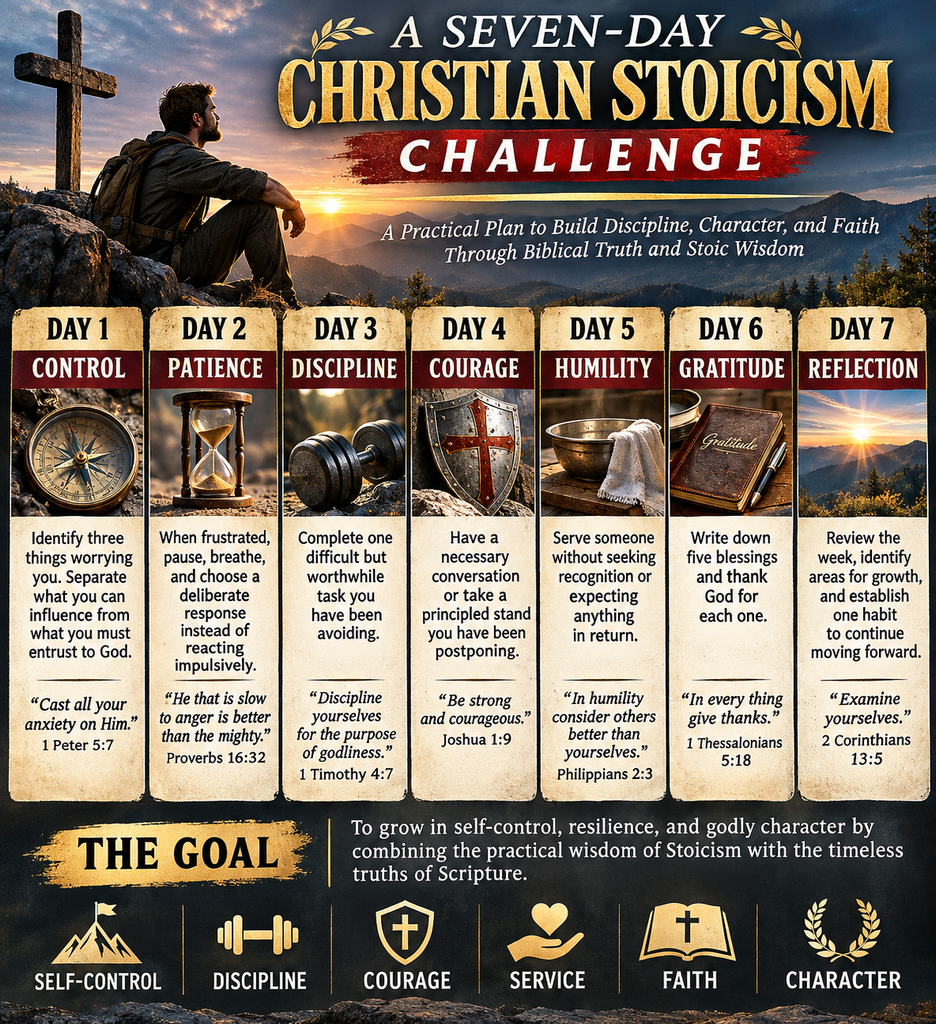
The purpose of this challenge is not to achieve perfection in seven days. It is to demonstrate that meaningful personal development begins with intentional choices repeated consistently. Christian character is cultivated over a lifetime, and every day presents another opportunity to practice the virtues we claim to value.
Conclusion: The Christian Warrior’s Greatest Battle Is Within
The modern world offers men countless definitions of success. Wealth, status, physical strength, professional achievement, and public recognition all compete for our attention. While none of these things is inherently wrong, they become dangerous when we mistake them for the ultimate measure of a man’s worth.
Stoic philosophy reminds us that circumstances do not have to dictate character, that emotional discipline is a form of strength, and that adversity can become an opportunity to practice virtue. Christianity adds a deeper spiritual foundation, calling men to place their trust in God, follow the example of Jesus Christ, and understand that genuine greatness is expressed through love, humility, courage, and service.
A Christian man does not need to choose between being strong and being compassionate, between discipline and grace, or between courage and humility. The life of Christ demonstrates that these qualities are not contradictions. They are complementary expressions of mature character.
Perhaps the greatest lesson we can take from the Stoics is that the most important victories are often the ones nobody else sees. The moment you choose patience over anger, integrity over convenience, forgiveness over resentment, or responsibility over comfort, you have won a battle that matters.
But for the Christian, the journey does not end with mastering oneself. It continues through surrendering one’s life to God and allowing that faith to shape every responsibility, relationship, and decision.
Be disciplined like a Stoic, courageous like a warrior, humble like a servant, and faithful like a disciple of Christ.
The world may never become easier to navigate, but through faith, wisdom, and character, you can become better equipped to face it.
References and Further Reading
For readers interested in exploring the philosophical and biblical foundations of Christian Stoicism, these resources provide useful starting points.
1. Epictetus — The Enchiridion. A foundational Stoic handbook examining self-control, responsibility, and the distinction between what is and is not within our power. Read the Enchiridion. Ad Fontes Library
2. Marcus Aurelius — Meditations. Personal reflections on courage, duty, adversity, humility, and moral character. Read Meditations at Project Gutenberg.
3. Stanford Encyclopedia of Philosophy — Stoicism. Scholarly examination of Stoic ethics, virtue, reason, and the philosophical tradition. Explore the Stanford reference. Stanford Encyclopedia of Philosophy
4. The Holy Bible — King James Version. Particularly Proverbs 3:5–6, Proverbs 16:32, Romans 5:3–5, Galatians 5:22–23, Philippians 2:3, and 1 Corinthians 9:25. Read the King James Version.
5. Seneca — Moral Letters to Lucilius. Ancient Stoic writings exploring adversity, moral responsibility, friendship, and the disciplined life. Read Seneca’s letters.