
The Outrage Economy – Congratulations. Your righteous indignation has been monetized, your attention has been hijacked, and somewhere in Silicon Valley, someone is getting rich because you argued with a stranger about something stupid.
There was a time when being offended was an occasional inconvenience, like stepping in dog crap, getting cut off in traffic, or discovering your favorite bar had switched to light beer. You got irritated, muttered something inappropriate under your breath, and went about your day. Today, however, being offended has become something of a competitive sport, complete with professional participants, enthusiastic spectators, and an endless supply of self-appointed referees. Entire online careers are built around discovering the next outrageous statement, inappropriate joke, controversial advertisement, or poorly worded celebrity opinion. And the best part? While millions of Americans are busy screaming at one another through their smartphones, the companies hosting these digital cage matches are counting the money.
Welcome to the outrage economy, where anger is currency, indignation is entertainment, and your emotional stability is apparently a negotiable commodity. Social media was supposed to connect humanity, encourage conversation, and democratize the exchange of ideas. Instead, we’ve created a digital version of the Jerry Springer Show, except everybody gets a microphone, nobody has to pass a psychological evaluation, and the audience can participate without putting on pants. The most disturbing part isn’t that people are angry. Human beings have been arguing since the first caveman accused his neighbor of stealing his favorite rock. What’s different is that we’ve built an extraordinarily sophisticated technological infrastructure that can turn those arguments into an endlessly renewable source of attention and revenue.
The Algorithm Doesn’t Care If You’re Right. It Cares If You’re Angry.
Imagine walking into a bar where the bartender deliberately brings up every subject guaranteed to irritate you. Politics, religion, your favorite sports team, that ridiculous thing your brother-in-law said at Thanksgiving. Every time you get worked up, he introduces another argument, knowing you’ll stick around to defend your position. Eventually, you realize the bartender isn’t interested in your opinions. He’s interested in keeping you on the stool buying drinks.
That’s essentially how engagement-driven social media can operate, except the bartender is an algorithm, the drinks are advertisements, and the establishment never closes.
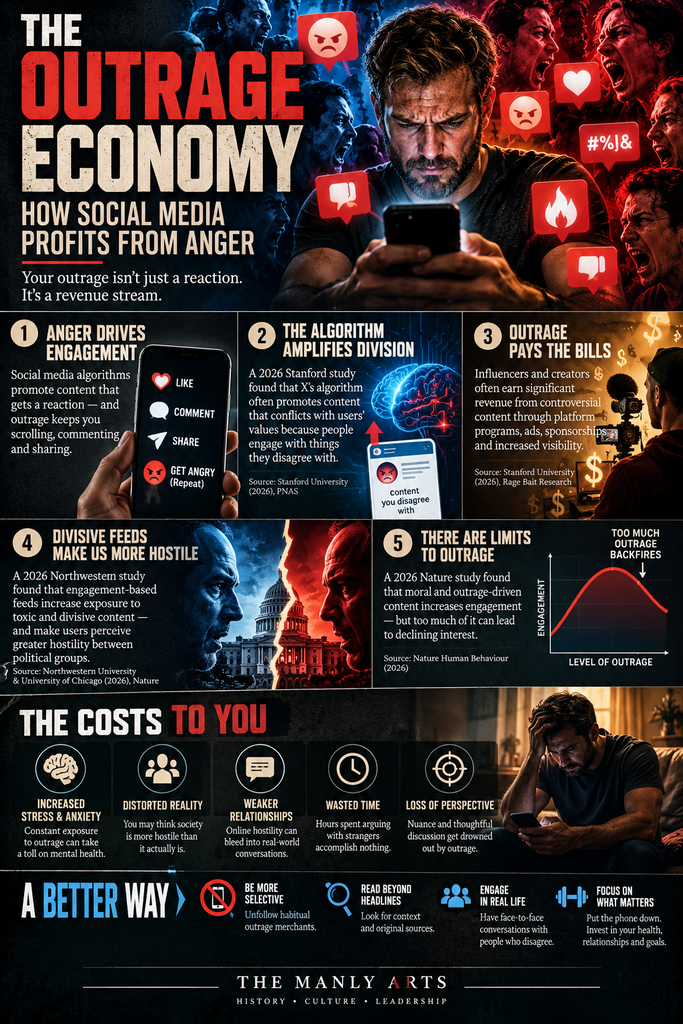
A 2026 Stanford University study published in Proceedings of the National Academy of Sciences examined the social media feeds of 715 American X users. Researchers found that content promoted through the platform’s algorithmically ranked feed was often misaligned with users’ stated personal values. The explanation was revealing: people frequently engage with material they disagree with, and the algorithm can interpret that engagement as a signal to deliver more of it.
In other words, when you angrily respond to some ridiculous political statement, you may be teaching the platform that you would appreciate an entire buffet of equally ridiculous political statements. Congratulations. You’ve successfully trained your digital assistant to annoy the hell out of you.
Stanford computer science professor Michael Bernstein explained the underlying problem: platforms treat engagement as a measure of interest, even though people sometimes engage because they’re furious. The system doesn’t necessarily distinguish between something you love and something you absolutely despise. Both can generate attention, and attention is valuable.
This doesn’t mean every social media company deliberately programs its algorithms to make users miserable. The research is more specific than that. It demonstrates how systems designed to maximize engagement can produce undesirable consequences even without an explicit instruction to promote outrage. The distinction matters, although it probably offers little comfort when your morning coffee is interrupted by your fourteenth argument about a politician you’ve never met.
Congratulations, Being Offended Is Now a Career
Once upon a time, people became famous by accomplishing something remarkable. They wrote books, built businesses, won championships, invented useful products, or demonstrated some recognizable talent. Today, you can achieve internet celebrity by filming yourself reacting dramatically to something another person said on a podcast.
The formula is remarkably simple. Find a controversial statement, remove any inconvenient context, announce that you’re deeply offended, and invite several million strangers to share your emotional distress. For additional engagement, make sure your facial expression suggests you’ve just discovered someone microwaving a kitten.
Of course, outrage merchants exist across the political spectrum. Conservatives have their professional provocateurs, progressives have theirs, and the internet provides enough ammunition for both sides to remain perpetually irritated. One group is furious because a corporation changed its advertising campaign. Another is furious because a comedian told an offensive joke. Somebody else is demanding a public apology because a celebrity expressed an opinion that apparently violated the Geneva Convention of Acceptable Feelings.
And before anyone starts congratulating themselves for belonging to the sensible side of this madness, remember that every political tribe believes its outrage is principled while everyone else’s is hysterical.
The economic incentives are real. Stanford communication researcher Angèle Christin explained in a 2025 examination of rage bait that some creators earn money through platform programs tied to views and advertising. Provocative content can attract attention, including from people who strongly disagree with it. Those reactions can increase visibility, potentially generating additional revenue.
Not every angry influencer becomes wealthy, and viral success is notoriously unpredictable. Christin also described creators struggling with unstable earnings, burnout, and the relentless pressure to keep producing attention-grabbing material. Nevertheless, the business incentive is obvious: if controversy attracts an audience, controversy becomes part of the product.
We used to tell children that throwing tantrums wouldn’t get them what they wanted. Apparently, nobody explained that principle to the influencer economy.
Political Tribalism: The Internet’s Favorite Blood Sport
Perhaps nowhere is the outrage economy more successful than in American politics, where social media has transformed ideological disagreement into a full-contact spectator sport.
A conservative posts something provocative. A progressive responds with righteous fury. A conservative influencer shares the response as evidence that the left has lost its mind. A progressive influencer shares that reaction as evidence that the right has lost its mind. Both audiences applaud, both creators gain exposure, and somewhere in the middle, the original issue disappears beneath an avalanche of insults, memes, and accusations of moral bankruptcy.
It’s a beautiful system, provided your definition of beauty involves two people setting fire to a house while arguing over who owns the matches.
The more troubling issue is that social media may distort our perceptions of how hostile our fellow Americans actually are. A 2026 study published in Nature examined how different social media feed algorithms affected political content during the 2024 presidential election. Researchers randomly assigned 2,000 participants to different feed-ranking systems and found that engagement-based feeds amplified emotionally charged, morally contentious, and toxic political material compared with chronological feeds. They also increased participants’ perceptions of hostility between political groups.
Think about what that means. The loudest, angriest voices online can become disproportionately visible, potentially creating the impression that everybody on the other side of an issue is a raving lunatic. Meanwhile, millions of ordinary Americans are going to work, raising families, paying mortgages, coaching Little League, and occasionally having perfectly civilized conversations with neighbors who vote differently.
Those people rarely go viral. Apparently, a video titled “Two Reasonable Adults Disagree Respectfully About Tax Policy” doesn’t generate the same excitement as a screaming match outside a school board meeting.
The danger isn’t simply that Americans disagree. Disagreement is fundamental to a free society. The danger emerges when we begin treating political opponents as enemies, confusing the most extreme online personalities with ordinary citizens, and assuming that every difference of opinion represents a profound moral defect.
Democracy requires disagreement. It doesn’t require everybody to behave like an intoxicated professional wrestling villain.
The Great Victimhood Olympics
Another curious development in the outrage economy is the transformation of personal offense into a form of social status. Being offended is no longer necessarily something to resolve. In certain online environments, it can become something to display, celebrate, and occasionally weaponize.
This doesn’t mean genuine discrimination, injustice, or offensive behavior should be ignored. Some situations deserve public criticism, accountability, and meaningful action. The problem begins when every awkward interaction, poorly chosen phrase, or disagreement becomes evidence of an existential social crisis.
A celebrity makes a clumsy joke. Someone discovers an unfortunate advertisement from 2007. A stranger expresses an unpopular opinion. Suddenly, the digital town square is filled with demands for apologies, boycotts, resignations, and public demonstrations of remorse.
The remarkable thing is how quickly the outrage cycle moves. Yesterday’s unforgivable scandal becomes today’s forgotten controversy, replaced by something even more shocking, offensive, or absurd. It’s difficult to sustain genuine moral indignation when the internet demands a fresh emotional emergency every six hours.
There is also a psychological cost to living in a perpetual state of confrontation. If every disagreement becomes a personal attack, every joke becomes an insult, and every controversial opinion becomes a threat, ordinary human interaction starts looking like a minefield. People become reluctant to speak candidly, humor loses its spontaneity, and conversations that might once have produced understanding instead become exercises in ideological self-defense.
The irony is that a culture obsessed with protecting people from discomfort can end up producing an extraordinary amount of it.
Science Says We Like Moral Outrage—But Even That Has Limits
One of the more interesting developments in this field arrived in September 2026, when researchers published a study in Nature Human Behaviour examining more than 1.6 million observations across Twitter, Reddit, and 8chan.
The researchers found that morally relevant language was associated with greater engagement, but there was an important qualification: increasing the concentration of moral language beyond a certain point was associated with declining engagement. In effect, outrage can attract attention, but overwhelming people with moralistic messaging may eventually produce diminishing returns.
Apparently, even the internet has a limit to how many times it wants to be lectured about the imminent collapse of civilization.
This finding complicates the popular assumption that more outrage automatically means more engagement. Human behavior is messier than that, and different platforms, audiences, and contexts can produce different outcomes. Still, the broader research reinforces an important point: the emotional tone of online content influences how people interact with it.
The result is a digital environment in which creators, politicians, activists, and media personalities have incentives to package their messages for maximum emotional impact. Nuance becomes an inconvenience. Context becomes optional. And thoughtful discussion must compete against a headline announcing that someone, somewhere, has done something absolutely outrageous.
Social Media Isn’t Broken. It’s Doing What We Reward.
Here’s where the conversation becomes uncomfortable. It’s tempting to blame everything on Silicon Valley executives, manipulative algorithms, and attention-hungry influencers. They’re certainly part of the problem, but the machinery doesn’t operate independently of us.
We click. We comment. We share. We argue. We return the next morning to see whether the stranger who called us an idiot has responded to our devastating rebuttal.
We’ve become willing participants in a system we routinely complain about.
And while algorithms influence what we see, we still have some control over what we choose to engage with. We can decline to respond to obvious provocations. We can stop following personalities whose primary contribution to public discourse is making everybody miserable. We can read beyond headlines, examine original sources, and occasionally entertain the radical possibility that someone who disagrees with us might have a reasonable argument.
The encouraging news is that changing the system may not require eliminating everything entertaining about social media. In the Northwestern University and University of Chicago experiment published in Nature, researchers tested an alternative feed-ranking approach that reduced the disproportionate influence of extreme users. Participants encountered less toxic and divisive content while reporting comparable enjoyment of the platform.
That’s a significant finding. It suggests that reducing the amplification of hostility doesn’t necessarily mean creating a boring internet filled exclusively with inspirational quotes, vacation photographs, and videos of golden retrievers.
It also challenges the convenient excuse that platforms have no choice but to amplify inflammatory material because that’s all people want to see.
Better design is possible. So is better behavior.
The Most Rebellious Thing You Can Do Is Refuse to Be Outraged
Perhaps the greatest irony of modern social media is that we’ve never had more access to information, yet we’ve become remarkably skilled at turning that information into reasons to dislike one another. We have extraordinary technology capable of connecting people across continents, sharing scientific discoveries, supporting small businesses, and spreading useful knowledge. Instead, a substantial portion of our collective digital energy is spent arguing over screenshots, defending celebrities who don’t know we exist, and debating whether someone should be fired for a joke they made during the Obama administration.
What a magnificent achievement for human civilization.
The solution isn’t to abandon strong opinions, stop challenging bad ideas, or pretend every perspective deserves equal respect. Some arguments are foolish. Some policies are harmful. Some people genuinely deserve criticism. But there’s a difference between standing up for something important and allowing every manufactured controversy to commandeer your attention.
You don’t have to attend every argument you’re invited to. You don’t have to respond to every insult, correct every stranger, or participate in every internet crusade. Sometimes the most effective response to an obvious provocation is to recognize it for what it is and keep scrolling.
Better yet, put the phone down. Spend time with your family. Hit the gym. Read a book. Call an old friend. Have a conversation with someone whose opinions differ from yours without treating it like the opening round of a heavyweight championship fight.
The outrage economy depends on your attention, your emotional investment, and your willingness to keep feeding the machine. Take those things away, and its influence over your life begins to shrink.
Because in a world where everybody is competing to be the loudest, angriest, and most offended person in the room, perhaps the most genuinely rebellious thing a man can do is maintain his composure, think for himself, and refuse to participate in the circus.
After all, the internet may be free, but your attention is worth something. Stop giving it away to idiots.