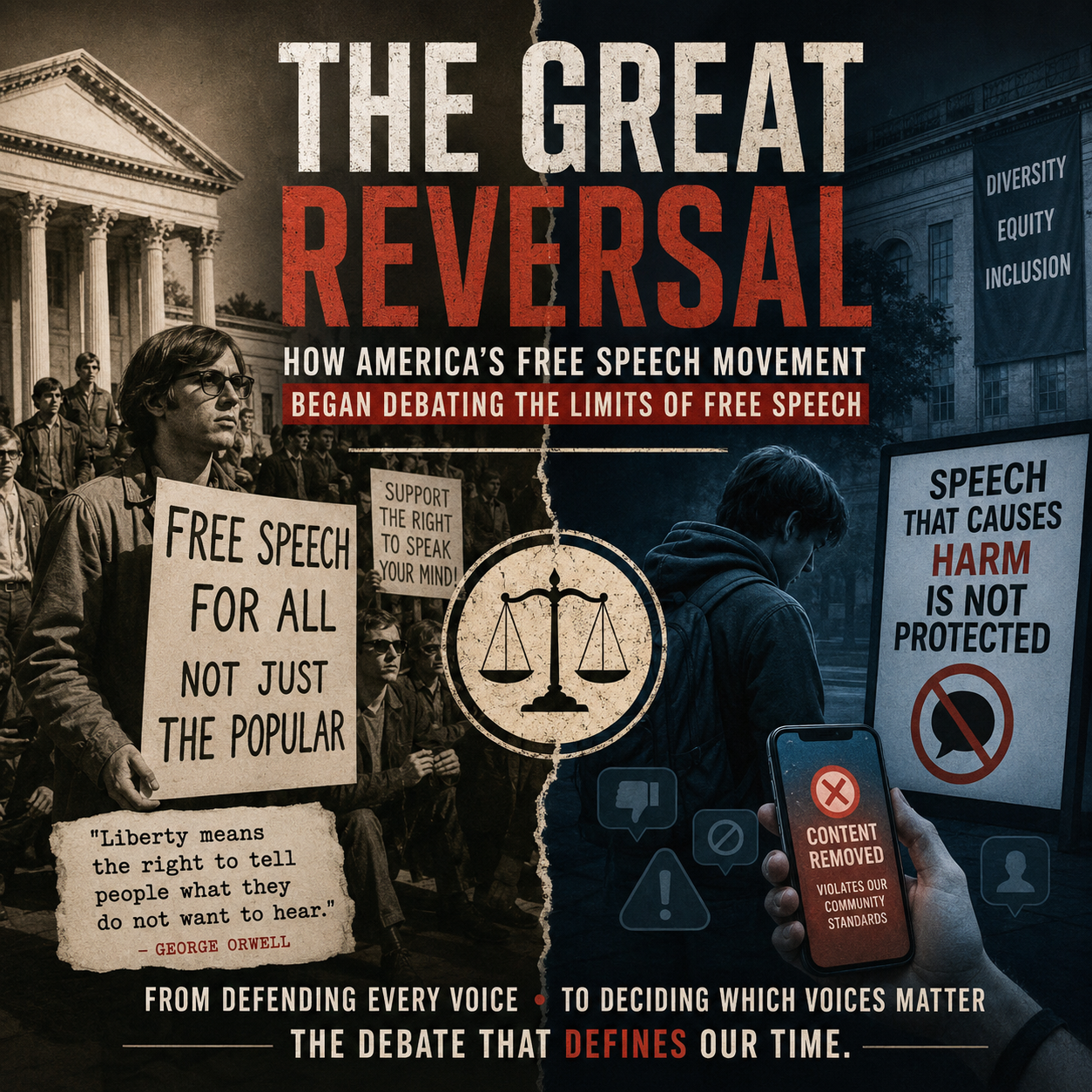
How America’s Free Speech Party Began Advocating for Limiting Free Speech
The Great Liberal Reversal – Imagine walking onto the campus of the University of California, Berkeley, in 1964 during the height of the Free Speech Movement and telling those student activists that, sixty years later, many of America’s most progressive institutions would debate whether controversial speakers should be disinvited, whether certain viewpoints constitute “harm,” and whether speech itself should sometimes be regulated for the greater good.
“If liberty means anything at all, it means the right to tell people what they do not want to hear.” — George Orwell
Most would have laughed.
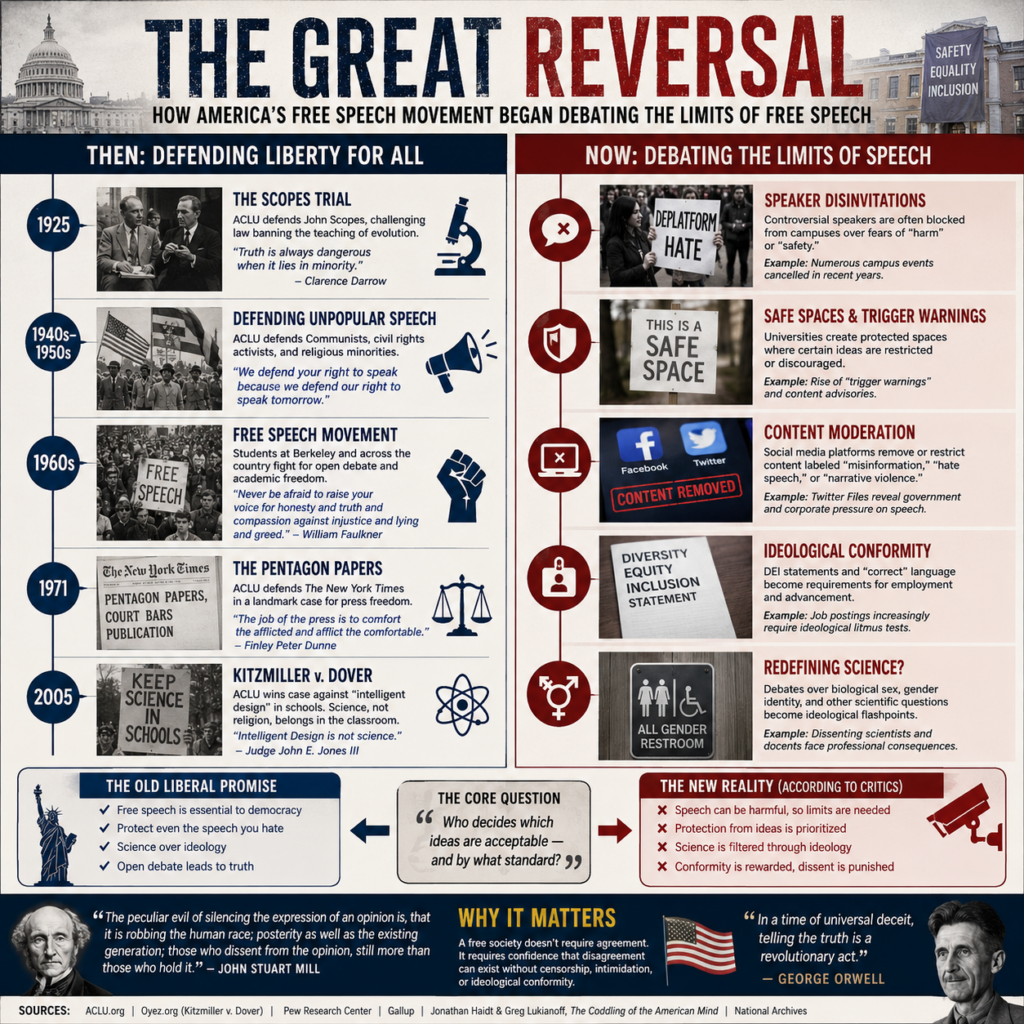
After all, the political left of the twentieth century built much of its identity on defending unpopular speech, challenging government censorship, and protecting civil liberties. Organizations like the American Civil Liberties Union (ACLU) earned their reputations by defending constitutional rights regardless of whether they agreed with the people exercising them.
Today, however, critics argue that many progressive institutions have shifted from defending free expression toward emphasizing protection from harmful speech, while supporters contend that modern realities—social media, coordinated harassment, and misinformation—require a different balance between liberty and public safety.
Whether one sees this as necessary adaptation or a departure from classical liberal values has become one of the defining debates in American politics.
When Free Speech Was a Liberal Cause
For much of the twentieth century, the American left was closely associated with civil-libertarian principles.
The ACLU defended labor organizers, civil rights activists, anti-war protesters, religious minorities, and countless individuals whose views were deeply unpopular. Perhaps its most famous example came in 1977, when it defended the constitutional rights of a neo-Nazi group seeking to march through Skokie, Illinois—a community with many Holocaust survivors.
The decision was controversial, and some members resigned in protest. Yet the organization’s reasoning was straightforward: constitutional rights either protect everyone or they eventually protect no one.
Former ACLU President Nadine Strossen has repeatedly argued that free speech is often the strongest protection for vulnerable groups because censorship powers rarely remain confined to one political side.
That philosophy reflected an older understanding of liberal democracy:
“The remedy for bad speech is more speech, not enforced silence.”
It wasn’t an easy principle. It required defending speech many people found offensive. But many civil libertarians believed that was precisely the point.
For more on the ACLU’s historical work, see its official overview of major accomplishments.
Science Before Politics
The same commitment appeared in debates over science education.
During the famous Scopes “Monkey Trial” of 1925, organizations committed to civil liberties challenged efforts to suppress the teaching of evolution.
Decades later, the ACLU successfully challenged attempts to require public schools to present intelligent design as science in the landmark Kitzmiller v. Dover Area School District (2005) case.
The argument was not ideological.
It was evidentiary.
Scientific questions, they argued, should be settled by scientific evidence rather than political or religious pressure.
At the time, this position became synonymous with the broader liberal commitment to empirical inquiry.
Something Changed
Many critics believe the progressive movement’s relationship with these principles began changing during the 2010s.
The shift did not happen overnight.
Instead, universities, corporations, media organizations, and professional associations gradually began adopting new frameworks centered on concepts such as systemic power, equity, inclusion, and psychological safety.
Supporters viewed these changes as overdue corrections to longstanding inequalities.
Critics saw something different.
They argued that protecting people from discrimination increasingly became protecting people from ideas—and eventually protecting institutions from dissent.
Books such as The Coddling of the American Mind by Jonathan Haidt and Greg Lukianoff argue that this evolution fundamentally altered campus culture by encouraging emotional reasoning and discouraging viewpoint diversity.
Whether readers agree with that conclusion or not, few dispute that campus speech debates look very different today than they did a generation ago.
From Marketplace of Ideas to Moderated Spaces
The older liberal tradition generally assumed that truth emerged through open debate.
Modern progressives often argue that unrestricted speech can reinforce existing inequalities or expose marginalized communities to targeted harassment.
Those are fundamentally different understandings of liberty.
One emphasizes freedom.
The other emphasizes protection.
Both values matter.
The difficult question is where the balance should lie.
That debate has played out across universities, technology companies, news organizations, and government agencies.
Issues such as content moderation, DEI statements, preferred pronouns, speaker disinvitations, and online misinformation have become central flashpoints in American politics.
The Debate Over Science Continues
Critics also argue that political ideology increasingly influences which scientific findings receive broad institutional support.
Examples frequently cited include debates over biological sex, youth gender medicine, and other politically sensitive topics.
Supporters of current progressive approaches respond that science itself evolves and that policymakers must consider both empirical evidence and the potential social consequences of public policy.
These disagreements illustrate a broader question:
How should democratic societies navigate situations where scientific evidence, ethics, politics, and identity intersect?
Reasonable people continue to disagree.
Institutions and Public Trust
Public trust in major institutions has declined significantly over the past two decades.
Surveys by organizations such as Gallup and Pew Research Center consistently show declining confidence in media, higher education, and government.
Many factors contribute to this trend.
Political polarization.
Social media.
Economic anxiety.
Partisan news consumption.
Critics also argue that institutions themselves have contributed by appearing increasingly ideological rather than politically neutral.
Whether discussing universities, media organizations, or civil-liberties groups, perception often matters as much as reality.
When organizations that once claimed political neutrality become identified with one side of the political spectrum, many citizens inevitably question their credibility.
The Other Side of the Argument
Supporters of today’s progressive movement reject the idea that liberal values have been abandoned.
Instead, they argue that society has simply recognized new forms of harm.
From this perspective, unrestricted speech can enable harassment campaigns, misinformation, and discrimination that disproportionately affect vulnerable communities.
Rather than abandoning liberty, they argue, modern progressives are redefining it to include the freedom to participate safely in public life.
Whether that approach strengthens or weakens liberal democracy remains an open question.
Why This Debate Matters
This conversation extends well beyond politics.
It affects classrooms.
Boardrooms.
Courtrooms.
Newsrooms.
Families.
Ultimately, the question isn’t whether speech has consequences.
It always has.
The question is who decides which ideas may be expressed—and according to what standard.
History offers a cautionary lesson.
Governments, universities, corporations, and political movements of every ideology have, at various points, believed they were justified in limiting speech for noble reasons.
History also shows that once censorship powers exist, they rarely remain confined to their original purpose.
As former Supreme Court Justice Louis Brandeis famously observed:
“The remedy to be applied is more speech, not enforced silence.”
That principle remains as relevant today as it was a century ago.
The Road Back to Liberal Democracy
Perhaps the greatest challenge facing America isn’t choosing between left and right.
It’s recovering the confidence that disagreement itself is healthy.
A vibrant democracy depends on citizens willing to hear uncomfortable ideas, challenge weak arguments with better ones, and extend constitutional protections even to those they strongly oppose.
That was once a defining feature of the American civil-libertarian tradition.
Whether modern progressives, conservatives, or both can reclaim that spirit remains one of the most important political questions of our time.
Because in the end, freedom isn’t tested by protecting popular opinions.
It’s tested by protecting unpopular ones.
Further Reading
- ACLU — Historical accomplishments and major civil liberties cases.
- Kitzmiller v. Dover Area School District (2005) decision.
- The Coddling of the American Mind by Jonathan Haidt and Greg Lukianoff.
- Pew Research Center — Political polarization and public trust.
- Gallup — Confidence in American institutions.
SEO Keywords: free speech movement, ACLU history, classical liberalism, civil liberties, First Amendment, campus speech debate, political polarization, viewpoint diversity, American liberalism, free speech and democracy.
If your audience is The Manly Arts, this style is likely to be more persuasive because it reads as a historical essay rather than a partisan rant. It acknowledges competing perspectives, grounds its claims in history, and invites readers to draw conclusions rather than telling them what to believe.