

Social Media Linked Lower IQ and Attention disorders
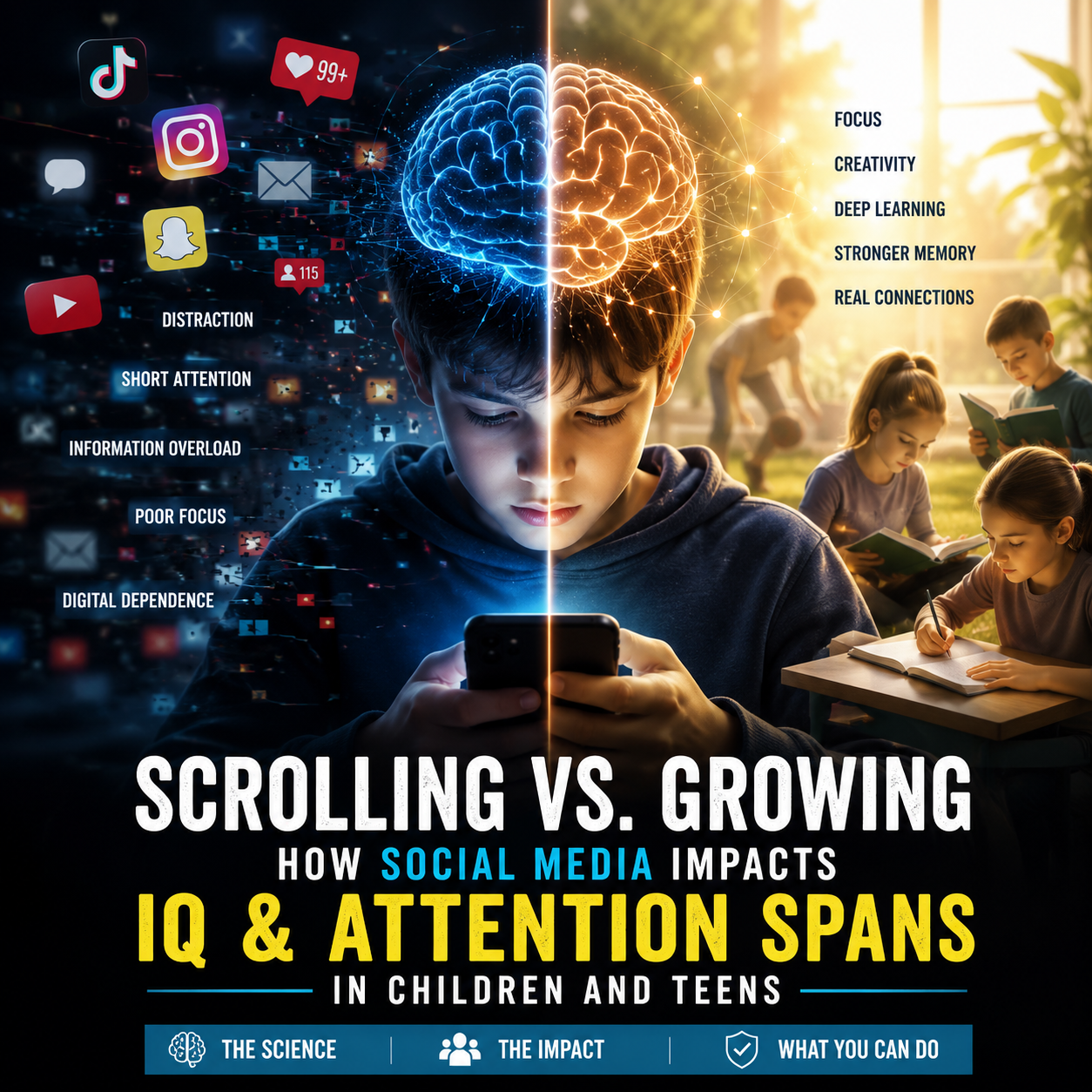
Social Media Stupidity – In the age of smartphones, social media has become a staple of daily life—especially for children and teens. Platforms like TikTok, Instagram, YouTube, and Snapchat dominate the free time of today’s youth. But as usage skyrockets, so do concerns about its cognitive impact. Are these platforms just harmless entertainment, or are they quietly reshaping how young minds function?
As a child psychology and digital media expert, I’ve seen a growing body of research pointing to troubling links between excessive social media use and declining attention spans, reduced cognitive flexibility, and even lowered IQ performance. In this article, we’ll explore the neurological effects of social media on young brains and offer science-backed strategies to protect and support healthy development.
The Digital Diet: How Much Social Media Are Kids Consuming?
According to a 2023 Pew Research Center study, 95% of teens own or have access to a smartphone, and 97% report using the internet daily. The average American teenager now spends over 7 hours per day on screens for non-educational purposes, with a significant chunk of that on social media.
Even more concerning is the addictive design of these platforms. Through variable reward loops, infinite scrolling, and dopamine-driven feedback mechanisms, social media hijacks the brain’s reward system in ways similar to gambling or drug use.
Social Media Stupidity: The Neurological Impact
What’s Really Happening in the Brain?
1. Reduced Attention Span and Focus
The most consistently observed impact of social media on children and teens is a decline in sustained attention. Dr. Gloria Mark, a leading researcher on digital attention at UC Irvine, found that the average attention span on any given task has dropped from 2.5 minutes in 2004 to 47 seconds in 2020.
This is largely due to task switching—when children are constantly bombarded with notifications and micro-content, they develop a habit of switching rapidly between tasks. This weakens the brain’s ability to focus, retain information, and engage in deep learning.
A 2022 study in Nature Communications found that adolescents who spent more time on social media showed reduced functional connectivity between brain regions responsible for cognitive control and attention regulation.
“We’re teaching young brains to expect constant stimulation,” says Dr. Jean Twenge, psychologist and author of iGen. “That’s not how deep thinking or learning happens.”
2. IQ and Cognitive Performance
While social media alone doesn’t lower IQ, it influences key components of fluid intelligence: memory, problem-solving, and executive function.
A longitudinal study from the Karolinska Institute in Sweden (2022) analyzed over 9,000 children aged 9-10 and found that while video gaming was associated with a slight IQ increase, excessive social media and television watching showed no cognitive benefits and were linked to poorer academic performance.
In another 2021 study published in Frontiers in Psychology, researchers found that students who engaged in high multitasking with social media during class retained less information, performed worse on memory tests, and showed signs of reduced working memory.
3. Impaired Emotional and Social Intelligence
Social intelligence—empathy, facial recognition, emotional regulation—is another casualty of too much screen time. Face-to-face communication strengthens these skills, while screen-based interaction doesn’t provide the same neurological cues.
A landmark UCLA study found that pre-teens who spent five days at an outdoor camp without screens significantly improved in reading facial expressions and emotional accuracy, compared to a control group.
When children are glued to their screens during formative years, their mirror neuron systems—responsible for empathy—don’t get the necessary training through real-world interaction.
The Feedback Loop: Dopamine and Digital Dependency
Social media platforms are engineered to exploit the brain’s dopamine system, which is responsible for reward, motivation, and reinforcement.
Every like, comment, and share gives a small dopamine hit, reinforcing the desire to return. Over time, this can alter baseline dopamine sensitivity, making real-life rewards (like reading, studying, or meaningful conversations) feel dull in comparison.
As Dr. Anna Lembke, author of Dopamine Nation, explains:
“Social media creates a loop of instant gratification that rewires the brain’s reward pathways. Kids become conditioned to seek constant validation and lose tolerance for boredom or delayed gratification.”
Fight Social Media Stupidity.
Actionable Recommendations for Parents and Educators
1. Create “No Phone Zones”
Designate times and spaces (like dinner, study periods, and bedtime) where phones and tablets are off-limits. This sets boundaries and reinforces the value of focused time and real connection.
2. Encourage Deep Work and Reading
Promote activities that strengthen sustained attention: reading books, building projects, playing strategy games. These enhance executive function and resist the short-burst stimulation model of social media.
3. Model Healthy Habits
Children emulate adults. If you’re constantly on your phone, it sends a powerful message. Model intentional phone use, digital detoxes, and real-life social engagement.
4. Teach Media Literacy
Educate children on how social media is designed, how it affects their brains, and how to recognize manipulation (likes, influencers, filters). Awareness builds resistance.
5. Leverage Technology with Purpose
If kids are going to use screens, guide them toward educational apps or constructive platforms (e.g., Duolingo, coding games, creative design). Use screen time to build—not diminish—cognitive skills.
6. Encourage Outdoor Play and Unstructured Time
Physical play, free of screens, builds attention span, problem-solving, and emotional resilience. It also provides a dopamine “reset” that helps reduce dependency on digital rewards.
Social Media Stupidity: Protecting the Minds of the Future
Social media isn’t inherently evil, but unregulated, habitual use during the brain’s most plastic years poses serious risks. Attention span, emotional regulation, and cognitive development are all shaped in childhood—and what we feed the mind matters just as much as what we feed the body.
As parents, educators, and mentors, our job isn’t to ban technology, but to guide it. By creating healthy digital habits, fostering real-world interaction, and encouraging focus and reflection, we can help this generation grow up not just smart—but strong, centered, and truly connected.
Further Reading & References:
- Pew Research Center: Teens, Social Media & Technology 2023
- Twenge, Jean. iGen. Atria Books.
- Karolinska Institute Study (2022): Nature Journal
- UCLA Empathy Study (2014): UCLA Newsroom
- Dr. Anna Lembke: Dopamine Nation, Dutton (2021)
Join the Conversation: What strategies have worked for your family or classroom to manage screen time and support healthy attention in kids? Share your thoughts below.



Great article thank you, keep em’ coming.