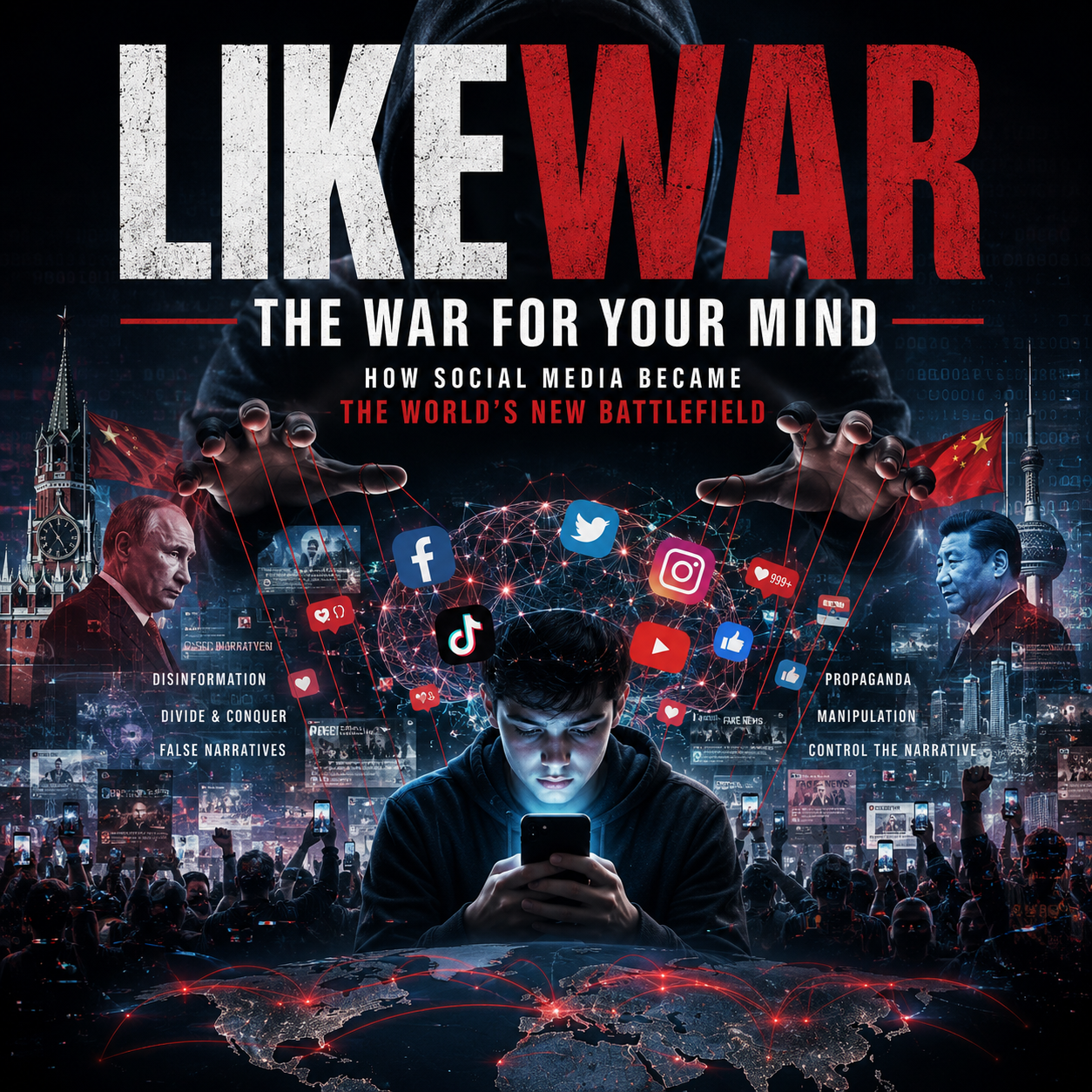
How Social Media Became the World’s New Battlefield
Likewar, The War for Your Mind marked a different era. In contrast, there was a time when going to war meant crossing a border. Additionally, armies captured cities, bombed factories, seized ports, and planted flags on conquered territory. Finally, victory could be measured on a map.
Today, some of the most consequential battles between nations are fought without a soldier crossing a frontier. The battlefield is everywhere. It is carried around in billions of pockets and checked hundreds of times a day. It is Facebook, TikTok, Instagram, YouTube, X, Telegram, Reddit. Whatever platform captures our attention next will join them. The prize is no longer simply territory. Increasingly, it is perception itself.
This is the unsettling reality behind Likewar, a term popularized by national-security strategist P.W. Singer and researcher Emerson T. Brooking. They describe the book The Weaponization of Social Media. Moreover, their argument is simple. Social media has grown beyond communication and entertainment to become a genuine arena of international conflict. Governments and other actors have discovered that controlling what people see can shape beliefs. That power could produce effects once achievable only through traditional political or military power.
The warning looks even more significant today. Social media platforms now combine enormous audiences with artificial intelligence, behavioral data, recommendation algorithms, influencers, automated accounts and instantaneous global distribution. Never before have governments and political movements possessed tools capable of reaching so many people, targeting them so precisely and measuring their reactions so quickly.
Former CIA and NSA director Michael Hayden described LikeWar as a warning about a world in which “truth is the first casualty,” while internet pioneer Vint Cerf observed that technology had “outrun our social intuitions about its power.” Those observations get to the heart of the problem. Humanity built the most powerful communication system in history before fully understanding what would happen when governments, corporations and political movements learned to manipulate it.
From Cyberwar to a Likewar, theWar Over Perception
Cyberwarfare traditionally evokes hackers in dark rooms trying to penetrate networks.
They steal classified information or shut down critical infrastructure.
In terms of Likewar, that remains a genuine national-security threat.
But information warfare operates differently.
A hacker attacks the computer, while an influence operator attacks the person.
That distinction makes social media extraordinarily valuable.
In addition, computer systems can be patched and updated.
They can be encrypted and protected by strong security.
However, human beings are considerably harder to firewall.
We are emotional creatures influenced by fear and anger.
We are also driven by loyalty, resentment, curiosity, tribal identity, and the desire to belong.
Modern propaganda does not necessarily need to create those emotions.
It only needs to identify them and push the right buttons.
This is a facet of Likewar.
A foreign government trying to destabilize another country therefore doesn’t always have to invent a political controversy. It can find one already dividing the population and pour gasoline on it. Racial tension, immigration, elections, religion, abortion, war, guns, policing, economic inequality and cultural disputes all provide ready-made fault lines. The objective may not even be persuading Americans to adopt a Russian, Chinese or Iranian worldview. Simply making Americans hate and distrust one another can accomplish something strategically useful.
That represents one of the great inversions of modern warfare. During previous conflicts, destroying an enemy’s communications infrastructure was a military objective. In the age of social media, an adversary may prefer that infrastructure to remain operational. Why blow up the communication network when you can use it to manipulate the population?
The Algorithm Never Sleeps
Social-media companies did not build their recommendation algorithms as weapons of war. They built them to keep people watching, clicking, commenting and sharing. Unfortunately, the qualities that make content commercially successful can also make propaganda extraordinarily effective.
The algorithm doesn’t necessarily care whether something is true. It cares whether people react to it.
Anger produces reactions. Fear produces reactions. Outrage produces reactions. Tribal conflict produces reactions. A calm explanation of a complicated political issue may require ten minutes of concentration, while a thirty-second video accusing the other side of destroying the country can generate millions of views before breakfast.
That gives modern influence operations something twentieth-century propagandists could only dream about: instantaneous feedback.
Imagine running propaganda operations during the Cold War. Governments printed newspapers, broadcast radio programs and distributed leaflets without immediately knowing which messages worked. Today, propagandists can watch likes, comments, shares, watch time and trending searches almost in real time. They can test dozens of narratives simultaneously, discard the failures and amplify whatever generates the strongest emotional response.
Propaganda has acquired analytics.
More importantly, social-media users provide much of the distribution themselves. A government may create the original message, but ordinary people carry it across the internet because it makes them angry, frightened or vindicated. One carefully designed piece of misinformation can therefore travel through millions of legitimate accounts without most of the participants realizing they have become part of an influence operation.
Russia and the Industrialization of Confusion
No country has become more closely associated with modern social-media influence operations than Russia. Moscow’s approach is often misunderstood as simply an attempt to convince Western audiences that Russia is right. The strategy can be considerably more sophisticated. Rather than persuading everyone to believe one version of events, Russian information operations have repeatedly been accused of flooding the information environment with competing narratives until audiences begin wondering whether anyone can be trusted.
The Internet Research Agency became the most famous example following the 2016 U.S. presidential election. Russian operators created social-media accounts that impersonated Americans and inserted themselves into existing political debates. Some posed as conservatives, others as progressives, activists or members of particular demographic communities. The point wasn’t always ideological consistency. It was engagement, division and amplification.
The strategy did not disappear after 2016. U.S. intelligence officials warned ahead of the 2024 presidential election that Russia remained one of the most active foreign influence threats, using intelligence services, cyber operators, state media, proxies and social-media personalities to influence Western political discussion. Officials described Moscow’s broader objectives as including weakening confidence in democratic institutions, intensifying social divisions and undermining Western support for Ukraine.
One particularly revealing example was the Russian operation known as Doppelganger. In September 2024, the U.S. Department of Justice announced the seizure of 32 internet domains allegedly connected to a Russian government-directed influence campaign. According to investigators, operators created websites that mimicked legitimate news organizations and then used fake personalities, social-media advertising and other distribution techniques to push audiences toward them.
The brilliance—and danger—of the technique lies in its disguise. Propaganda works better when the audience doesn’t recognize it as propaganda. A crude government message carrying the Kremlin’s logo immediately triggers skepticism. A professional-looking article appearing to come from a familiar Western news organization can bypass that psychological defense.
The propagandist doesn’t merely manufacture the story anymore. He can manufacture the newspaper, the journalist, the audience and the apparent public reaction to the story.
China and Influence at Enormous Scale
China has developed a somewhat different approach to the information battlefield. Beijing built one of the world’s most sophisticated systems for controlling information domestically through censorship, surveillance and platform regulation, but researchers have increasingly documented Chinese-linked influence networks operating beyond China’s borders.
One widely studied network is known as Spamouflage, a sprawling collection of accounts that researchers have linked to pro-Beijing messaging across numerous social platforms. Investigations have found operations producing material in multiple languages and attempting to influence discussions involving China, Taiwan, the United States and other geopolitical issues.
The arrival of generative artificial intelligence makes this strategy potentially much easier to scale. Researchers examining covert influence operations in 2024 found actors associated with China and other countries experimenting with AI to research social-media discussions, generate comments, translate material and create content in multiple languages.
European investigators have documented just how global the information battlefield has become. The European External Action Service reported hundreds of foreign information-manipulation incidents involving tens of thousands of accounts operating across dozens of countries and numerous platforms, identifying Russia as the dominant actor in its dataset while also documenting significant Chinese activity.
By 2026, European foreign-policy chief Kaja Kallas was describing the situation in explicitly military terms: “Today’s wars are not only fought with tanks and drones but with lies and algorithms too. The information space is a frontline in the fight for democracy.”
It is difficult to imagine a clearer description of LikeWar.
When Terrorists Became Social-Media Influencers
Perhaps the most disturbing aspect of this transformation is that governments aren’t the only players capable of competing. Social media dramatically lowered the cost of propaganda, allowing relatively small organizations to communicate internationally without owning television networks, newspapers or radio stations.
ISIS demonstrated this with chilling effectiveness during its rise in Iraq and Syria. The organization combined battlefield footage with sophisticated video editing, social-media campaigns, memes, religious messaging and direct online recruitment. Terrorists were adopting techniques that looked strangely similar to modern consumer marketing.
The significance went far beyond ISIS. Extremist organizations, militias, mercenary groups, activists, criminal organizations and political movements around the world recognized the same opportunity. A relatively small group armed with smartphones and a sophisticated understanding of online culture could potentially influence millions of people.
The AK-47 once democratized firepower by giving poorly equipped fighters inexpensive access to lethal force. The smartphone has done something similar to propaganda.
A teenager with editing software can now create media that once required a professional television studio. Artificial intelligence lowers that barrier even further, allowing almost anyone to generate realistic images, convincing voices, translated messages and increasingly sophisticated video.
Bots and the Illusion of the Crowd
One of the most powerful weapons in this new environment isn’t necessarily convincing content. It is the appearance of consensus.
Human beings naturally look toward other people when evaluating unfamiliar information. If thousands of people appear to support an idea, we instinctively treat that popularity as evidence that the idea deserves consideration. Social-media metrics turn that psychological tendency into visible numbers: likes, shares, views and followers.
Bots can manipulate those signals.
Imagine walking into a public square where ten thousand people are shouting the same political message. You would naturally assume a significant movement existed. Now imagine discovering that nine thousand of those people were machines.
The online equivalent happens every day.
In July 2024, the U.S. Justice Department announced action against what it described as an AI-enhanced Russian social-media bot farm, including nearly a thousand accounts. Investigators alleged that fictitious personas presented themselves as ordinary Americans while distributing messages favorable to Russian geopolitical interests.
The purpose of such networks isn’t merely to broadcast information. Artificial activity can create the impression that a message is already popular. That perception can attract real people, journalists and influencers, creating a feedback loop in which artificial momentum eventually generates genuine momentum.
A fake crowd can help create a real one.
Artificial Intelligence Enters the Fight
Generative AI represents the next escalation because it changes the economics of information warfare.
Traditional influence operations require people. Someone must write the propaganda, translate it, maintain fake accounts, respond to comments and generate new material. AI can accelerate almost every part of that process.
Investigations have already identified covert operations associated with actors from Russia, China, Iran and elsewhere using generative AI for tasks ranging from creating articles and comments to translating messages and developing fake personas.
There is, however, an important reason not to panic. Research into early AI-assisted influence campaigns found that using artificial intelligence did not automatically make those operations successful. Many struggled to attract authentic audiences despite their ability to generate enormous amounts of material.
That tells us something important about propaganda.
The machine may create the message, but human psychology still determines whether it spreads.
The more dangerous future is therefore not likely to be AI replacing propagandists. It will be AI making human propagandists faster and cheaper. Machines can create hundreds of messages, algorithms can identify which ones resonate, bots can manufacture initial momentum, influencers can provide credibility and ordinary users can complete the distribution.
That is an extraordinarily powerful information pipeline.
The Most Valuable Territory Is Between Your Ears
This is where the LikeWar concept becomes personal.
When warfare moves onto social media, there is no clearly defined front line. Ordinary citizens become participants whether they realize it or not. Every repost distributes information. Every angry comment increases engagement. Every viral video influences journalists, politicians and millions of other users about what society supposedly believes.
Your phone simultaneously makes you an audience member, a broadcaster, a source of behavioral data and a potential target.
Singer has warned against thinking about this phenomenon purely in terms of Russian election interference, arguing that “Russia is not the full story. Russia is just a chapter in a larger book.”
The larger story is the transformation of information itself into strategic terrain.
China wants influence. Russia wants influence. Iran wants influence. The United States conducts information operations. Political movements want influence. Corporations want influence. Activists want influence. Influencers want influence. Platforms themselves compete relentlessly for attention.
All of them are reaching into the same limited resource: the human mind.
When Nobody Believes Anything
The ultimate victory in information warfare may not come when everyone believes your propaganda. It may come when nobody believes anything.
Imagine an information environment in which every photograph might be AI-generated, every viral account might be a bot, every influencer might secretly be paid, every video might be manipulated and every news organization is automatically dismissed as propaganda by half the population.
Eventually people stop asking, “What is true?”
They begin asking, “Which version of reality belongs to my side?”
That is particularly dangerous for democratic societies because democracy does not require citizens to agree. It requires something much more fundamental: enough agreement about reality to make disagreement productive.
Citizens must believe that arguments can be resolved through evidence, debate, elections and legitimate institutions rather than violence. If an adversary can destroy that confidence, it may accomplish something an invading army would struggle to achieve.
You don’t necessarily have to conquer a rival society if you can convince its citizens to tear one another apart.
How Do We Fight Back?
The tempting response is censorship, but that cure can become as dangerous as the disease. Giving governments, corporations or technology companies unlimited authority to determine what citizens may see creates enormous potential for political abuse. A democratic defense against propaganda therefore has to be built around transparency and resilience rather than simply creating a Ministry of Truth.
Platforms should aggressively identify coordinated fake networks while being far more transparent about government influence campaigns and the recommendation systems deciding what billions of users see. Governments should publicly expose foreign information operations rather than quietly attempting to become better propagandists themselves. Journalists must resist the pressure to turn every viral post into breaking news before determining whether the underlying information is authentic.
But individuals have responsibilities too.
The most effective defense may be something remarkably old-fashioned: skepticism without cynicism. Read beyond headlines. Find original sources. Ask who benefits from a narrative. Be suspicious of anonymous accounts generating constant outrage. Check dates and context. Recognize when content seems almost perfectly designed to make you furious. Most importantly, resist the instinct to immediately share something simply because it confirms what you already believe.
That final habit matters because modern propaganda doesn’t always need to fool you completely. Sometimes it only needs to provoke you long enough to hit Share.
Welcome to World War Web
The defining weapon of twenty-first-century conflict may ultimately prove to be neither the hypersonic missile nor the autonomous drone. It may be the ability to influence millions of human beings without them realizing they are being targeted.
That is what makes the social-media battlefield unlike anything that came before it. The enemy doesn’t have to invade your neighborhood. He can enter through your newsfeed. The propaganda doesn’t arrive stamped with the seal of a foreign government. It arrives as a meme forwarded by your friend, a video recommended by an algorithm or a furious post from someone who appears to think exactly like you.
The battlefield has moved onto our screens, but its ultimate destination is the human mind. Information is the ammunition, algorithms provide the targeting system, social networks provide the delivery mechanism and attention is the territory everyone is fighting to control.
Welcome to World War Web.
The battle isn’t simply over what you see.
It’s over what you believe.
Further Reading
- LikeWar: The Weaponization of Social Media — P.W. Singer and Emerson T. Brooking
- U.S. Department of Justice — investigations into Russian influence operations and bot networks
- Office of the Director of National Intelligence — foreign threats to U.S. elections
- European External Action Service — Foreign Information Manipulation and Interference reports
- OpenAI — research into covert influence operations using generative AI