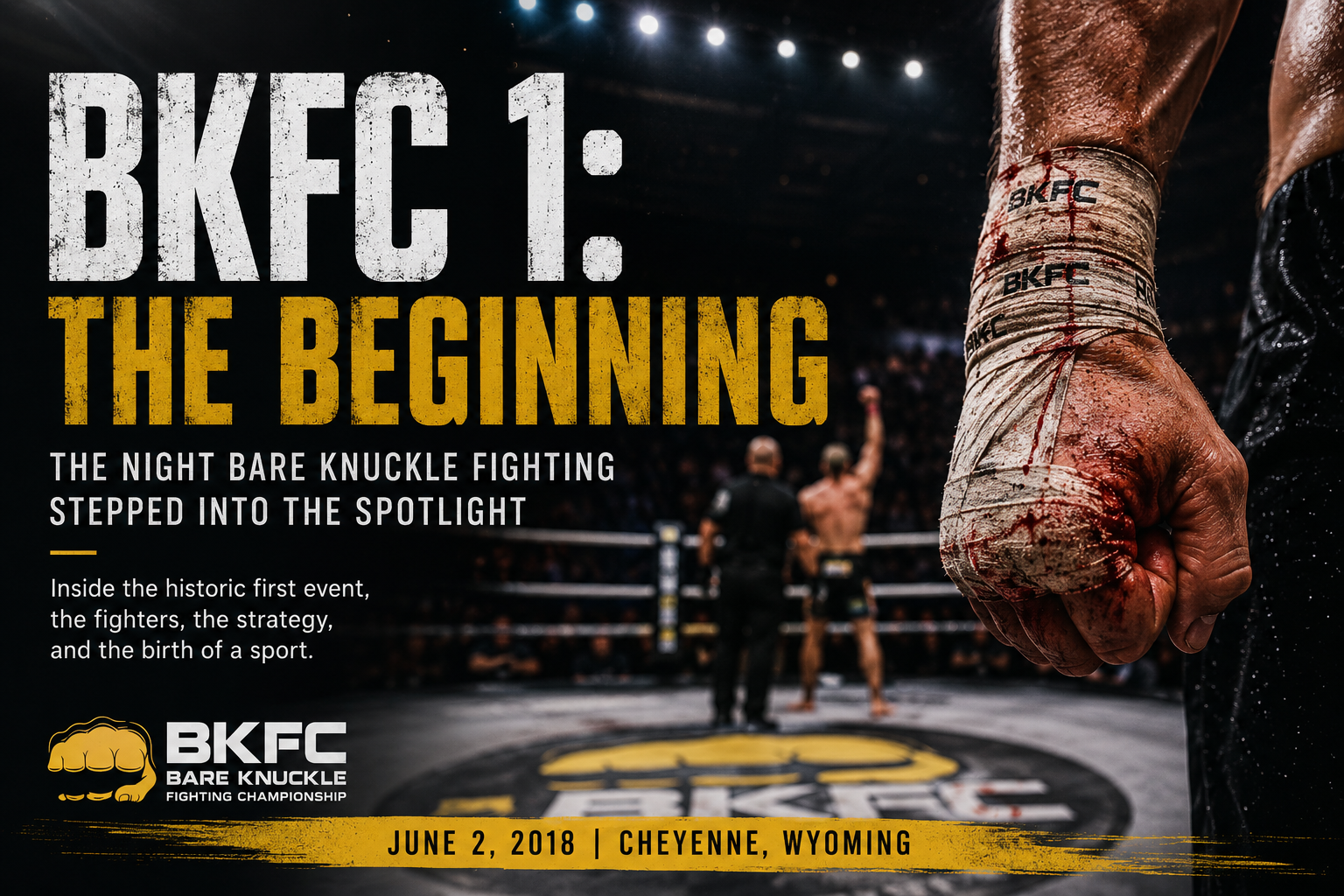
Inside BKFC 1, the night bare-knuckle fighting stepped out of the underground and began its unlikely transformation into a modern professional sport
By Steve Pellegrino
BKFC 1 – CHEYENNE, Wyo. — The first thing I remember wasn’t the blood. It was the uncertainty. On June 2, 2018, the crowd filing into the Cheyenne Ice & Events Center knew it was coming to see fights, but beyond that nobody could be completely certain what was about to happen. Bare-knuckle fighting had lived for generations somewhere between history, legend and the underground. Now it was being dragged beneath arena lights and presented as a regulated professional combat sport.
Some people expected a spectacle. Some expected a disaster. Most simply wanted to see what happened when professional fighters stepped into the ring and the gloves came off.
I had a different perspective. I was in the corner that night with two fighters, Maurice Jackson and Bobby Gunn, and my concerns were much more immediate. I wasn’t wondering whether bare-knuckle fighting could become a television product. I was thinking about distance, timing, hands, defense and what would happen when the opening bell rang.
Both of our fighters would be finished working before the first round ended.
And somewhere during those few frantic minutes, it became apparent that we weren’t simply participating in another fight card. We were watching a sport being reborn.
The Jab Still Matters
Jackson presented the kind of physical dimensions a coach notices immediately. He had height and reach, and there was no reason to surrender either by allowing the fight to become a telephone-booth brawl.
Our strategy was built around one of boxing’s oldest weapons: the jab.
I wanted Maurice long. I wanted him disciplined. Most of all, I wanted his opponent to have to cross dangerous territory every time he attempted to get close enough to punch.
That may sound elementary, but bare knuckle changes the mathematics of striking. A boxer wearing gloves can sometimes afford to throw combinations into guarded areas because the glove protects his hand. Remove that protection and accuracy becomes even more important. A forehead is suddenly a terrible target. Elbows are unforgiving. Poor wrist alignment can end your night as effectively as your opponent can.
The objective isn’t simply to hit hard. It’s to hit correctly.
Maurice understood that. He fought behind his reach, established his offense and earned a first-round knockout. From my position in the corner, the finish confirmed something I had suspected before the event: Good bare-knuckle boxing wasn’t going to be wild boxing.
It was going to require better boxing.
The absence of gloves magnified mistakes. Distance mattered more. Head movement mattered more. Footwork mattered more. Punch selection mattered more.
The sport looked primitive only if you didn’t understand what you were watching.
BKFC 1 – The Old Bare-Knuckle World Meets the New One
Then there was Bobby Gunn.
My history with Bobby went back to the underground bare-knuckle scene, years before there was a BKFC logo hanging above an arena or a sanctioned American promotion selling tickets to bare-knuckle events. Bobby had been carrying the tradition when there was little money, almost no mainstream recognition and certainly no expectation that the sport would eventually develop into an international business.
That history made his appearance in Cheyenne particularly meaningful.
Bobby didn’t need an elaborate tactical reinvention. With an experienced fighter, coaching is often about recognizing what he already does exceptionally well and pointing him toward the weakness standing across from him.
My message to Bobby was simple: Test the body.
Every experienced fighter knows the peculiar honesty of a body shot. Fighters can disguise fatigue. They can shake their heads after taking a clean punch upstairs and pretend it didn’t hurt. They can smile at an opponent and play to the crowd.
The liver doesn’t negotiate.
Bobby went downstairs and found what we were looking for. A liver punch produced the first-round stoppage, another emphatic ending on a night seemingly designed to introduce bare-knuckle fighting to an audience that didn’t yet know what to make of it.
For me, there was something fitting about watching Bobby win that way. One of the men who had helped keep bare-knuckle fighting alive outside the mainstream was now standing inside the ring as the sport entered its regulated era.
The underground and the future had met in Wyoming.
PAULIE MALIGNAGGI QUOTE:
“The sport looked primitive only if you didn’t understand what you were watching.”
BKFC 1 – Then the Crowd Understood
The atmosphere changed as the card progressed.
At the beginning of the night, curiosity dominated the building. Fans watched almost cautiously, waiting to determine whether what they were seeing was legitimate competition or merely a violent novelty.
Then punches started landing.
There was blood, certainly. Anyone pretending otherwise is selling something. Bare-knuckle fighting produces cuts, and those cuts provide some of the sport’s most dramatic images. The crowd reacted to them exactly as you’d expect.
But blood alone doesn’t hold an audience for very long.
Competition does.
The crowd began responding to the subtleties: the counterpunches, the exchanges, the momentum shifts and the fighters who could remain composed while another man stood directly in front of them trying to hurt them.
By the end of the night, the spectators weren’t trying to decide whether they liked bare-knuckle fighting.
They were simply watching fights.
That distinction was enormous.
A Different Science of Fighting
Bare-knuckle boxing occupies an unusual technical space between conventional boxing and mixed martial arts.
It looks familiar enough that anyone who has watched boxing can understand the basic objective, but removing the gloves changes defensive and offensive decisions. Traditional boxing gloves provide a substantial surface for blocking punches. Bare knuckle reduces that shield, increasing the value of movement, parrying, distance control and positioning.
The clinch creates another distinction. BKFC’s rules permit forms of clinch fighting that produce short punches and inside exchanges, giving the sport a rhythm that occasionally resembles old-school dirty boxing more than contemporary Queensberry boxing.
Then there is pacing.
BKFC fights are structured around short rounds and relatively short contests. That creates urgency. Fighters don’t have 10 or 12 rounds to collect information and slowly construct an attack. They must establish their game quickly without becoming reckless.
That balance—urgency without chaos—is one of the hardest things to coach.
The best fighters increasingly understand it.
They aren’t simply tough men willing to bleed. They are athletes learning a specialized discipline with its own timing, tactics and demands.
BKFC 1- From Experiment to Industry
What happened after that first night is perhaps more remarkable than what happened during it.
BKFC survived.
Then it grew.
The promotion began attracting established names from boxing and MMA while developing fighters whose identities became inseparable from bare knuckle itself. Mike Perry emerged as perhaps the clearest example of the latter phenomenon, finding in bare-knuckle fighting a competitive environment perfectly suited to his pressure, durability and personality. Established combat sports names followed, helping introduce the promotion to audiences who might never have purchased a bare-knuckle event otherwise.
The company eventually attracted another kind of validation when Conor McGregor became a part-owner in 2024, lending one of combat sports’ most recognizable names to BKFC’s expansion. BKFC has since continued pushing internationally while staging increasingly ambitious events. The promotion’s evolution is documented through its official event archive and expanding schedule.
BKFC official website and events
The important development isn’t simply celebrity involvement, however. It’s that bare-knuckle fighting has begun creating its own stars rather than surviving entirely on fighters established somewhere else.
That’s the difference between a novelty promotion and a sport.
The Question of Safety
No credible discussion of bare-knuckle fighting can avoid the obvious question: Is this really something professional sports should embrace?
The visual evidence can be alarming. Cuts and facial swelling are immediately apparent in a way that neurological trauma is not, and that creates an understandable perception that bare knuckle must automatically be more dangerous than gloved boxing.
The responsible answer is more complicated.
Combat sports carry unavoidable risks, including concussion, orthopedic injury and facial trauma. Bare-knuckle competition shouldn’t be marketed as safe simply because fighters may throw differently without gloves. Nor should visible cuts automatically be treated as proof that its overall injury profile is worse than every established combat sport.
The appropriate response is evidence, regulation and continued medical surveillance.
That means rigorous pre-fight examinations, competent athletic commissions, experienced referees, ringside physicians, appropriate suspensions after injuries and increasingly sophisticated concussion management. It also means resisting the temptation to match fighters simply because their names will sell tickets.
If bare knuckle wants the legitimacy of professional boxing and MMA, it must accept the same responsibility for athlete welfare—and eventually exceed it.
SUGGESTED PULL QUOTE:
“Bare knuckle doesn’t need to prove how tough its fighters are. It needs to prove how well it can protect them.”
What Comes Next
The next stage of BKFC’s development should be less about convincing people that bare-knuckle fighting exists and more about building the infrastructure that allows it to endure.
The sport needs a clearer athlete pipeline. Amateur boxers, kickboxers and MMA fighters interested in bare knuckle should have opportunities to learn its specialized mechanics before being placed under professional lights. Coaches should increasingly treat bare-knuckle preparation as its own discipline rather than simply taking a boxing or MMA camp and removing the gloves at the end.
Regulatory consistency matters just as much. Medical standards, matchmaking criteria and post-fight suspensions should become increasingly uniform as the sport expands into new jurisdictions. Long-term injury data should be collected and studied rather than replaced by assumptions from either critics or promoters.
And the promotion should never lose sight of what won over that uncertain crowd in Cheyenne.
The fights did.
Not manufactured hostility. Not spectacle for spectacle’s sake. Not the blood by itself.
The competition.
There is tremendous marketability in that simplicity. Bare knuckle produces short, dramatic fights that translate naturally to streaming, social media highlights and live audiences. But sustainable growth will depend on turning spectators into fans of individual fighters, divisions and championship races rather than viewers waiting for the next viral knockout.
BKFC 1 – What I Saw in Cheyenne
I sometimes think back to that night and how uncertain everything seemed before the first punch was thrown.
Maurice Jackson had a job to do, and we believed the jab and his reach would get it done. Bobby Gunn had a different job, and we believed testing the body would reveal the path to victory.
Both won in the first round.
Those victories remain meaningful to me as a coach, but with the benefit of time, I remember something else just as clearly: the audience discovering the sport in real time.
They came expecting something they couldn’t quite define. Some probably expected a bloodbath. Others came because the controversy itself was worth the price of admission.
Then they watched the fighters.
They saw skill alongside violence, tactics alongside toughness. They saw athletes forced to solve problems under extreme pressure without the protective margin provided by gloves. Most importantly, they cared about who won.
That night didn’t prove bare-knuckle fighting was destined to succeed. Nothing in professional sports is guaranteed.
It proved something more fundamental.
Bare-knuckle fighting could work.
Six years before Conor McGregor invested in BKFC and long before international expansion became part of the conversation, a crowd in Cheyenne watched two men step to the scratch lines, heard a bell ring and discovered that an old form of fighting could become something new.
I had one of the best seats in the building.
I was in the corner.