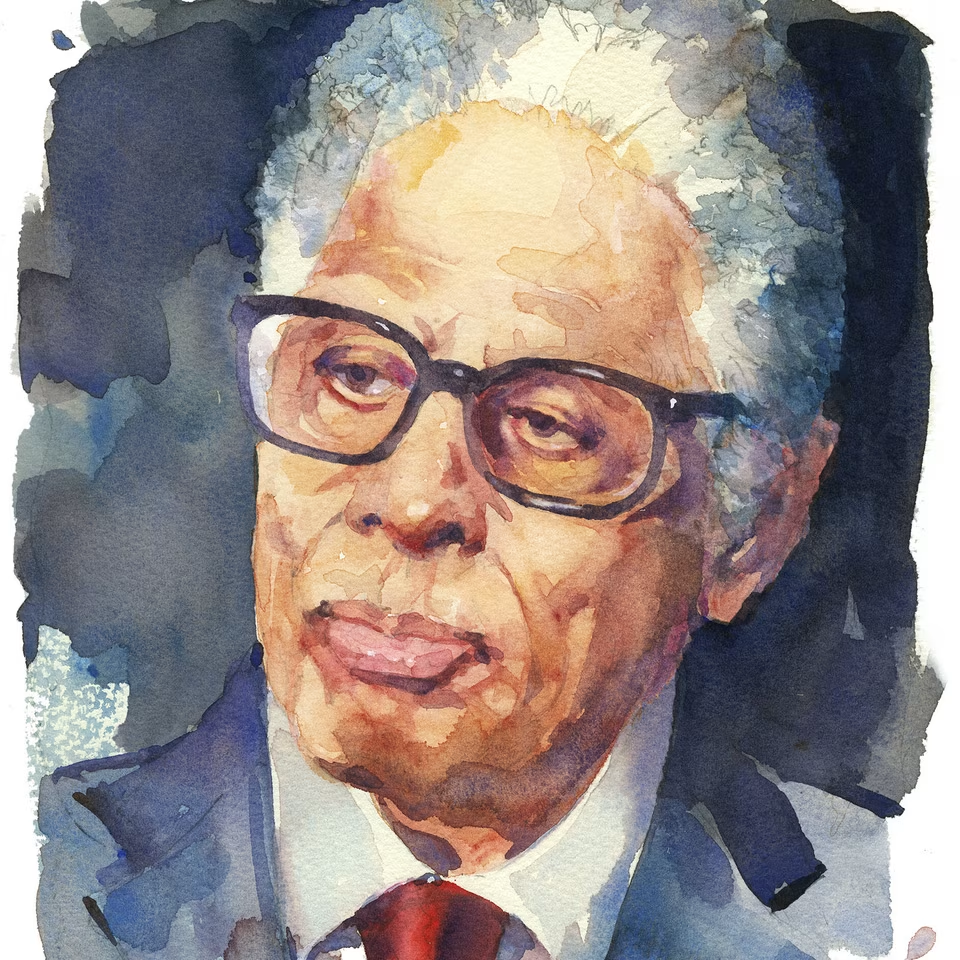
A Voice of Intellectual Independence and Self Reliance
Thomas Sowell is not just a prolific author or a contrarian economist—he’s a heavyweight intellectual whose work has reshaped how we think about economics, race, education, and public policy. Over a career spanning more than five decades, Sowell has published more than 30 books, hundreds of essays, and countless columns. A former Marxist who became a staunch advocate of free-market economics, Sowell has carved out a unique space as a thinker deeply skeptical of top-down social engineering and the unintended consequences of well-meaning government interventions.
Despite his retirement from public commentary in 2016, Sowell’s ideas remain as relevant as ever. His insights are cited by policymakers, economists, and everyday readers seeking clarity in an age of ideological noise. In this post, we’ll explore Sowell’s intellectual contributions—his economic philosophy, social theories, and real-world policy influence—with an eye toward why his work continues to resonate, particularly among men seeking reasoned, no-nonsense analysis in today’s polarized environment.
Thomas Sowell Philosophy: Incentives, Markets, and Trade-offs
At the heart of Thomas Sowell’s economic worldview is an unshakable belief in the power of incentives and trade-offs. Sowell contends that many economic and political debates boil down to a simple truth: there are no solutions—only trade-offs.
“You can’t have it all. You can’t even have all you want. We live in a world of trade-offs, not solutions.” — Thomas Sowell, Basic Economics
In his seminal work Basic Economics, Sowell lays out the principles of market-based economics in plain English. He takes abstract concepts and grounds them in real-world examples, helping readers understand how prices, competition, and property rights work to allocate resources efficiently—even when the outcomes are imperfect.
Sowell emphasizes that central planning fails not just because of corruption, but because it lacks the information needed to make efficient decisions—information that is naturally dispersed across millions of individuals and only accessible through market prices.
Drawing from the tradition of Friedrich Hayek and Milton Friedman (his mentor at the University of Chicago), Sowell’s economic thought is rooted in the idea that freedom and prosperity go hand-in-hand, and that economic knowledge is too complex to be monopolized by any governing elite.
Thomas Sowell Key Works:
- Basic Economics (2000): A comprehensive and accessible guide to how economies function.
- Applied Economics (2003): Extends economic principles to real-world issues like education, housing, and healthcare.
- Knowledge and Decisions (1980): Sowell’s most technical book, heavily influenced by Hayek’s theory of decentralized knowledge.
Social Theories: Culture, Race, and Disparities
Beyond economics, Sowell is perhaps best known for his provocative writings on race, culture, and social inequality. Rather than attributing disparities between groups to systemic oppression or discrimination alone, Sowell examines how cultural capital, historical context, and behavioral patterns affect outcomes across different societies.
“The most basic question is not what is best, but who shall decide what is best.” — Thomas Sowell
In books like Race and Culture (1994), Black Rednecks and White Liberals (2005), and Discrimination and Disparities (2018), Sowell dismantles the assumption that equal outcomes are a sign of justice—and that unequal outcomes automatically imply injustice. He argues that disparities are the historical norm, not the exception, and that they are often rooted in non-racial factors such as education, family structure, geography, and cultural habits.
One of Sowell’s most controversial and widely discussed claims is that many of the social problems faced by Black communities in America today were exacerbated—not alleviated—by the expansion of welfare and government intervention in the mid-20th century. He sees a dangerous pattern in which well-intentioned policies erode personal responsibility and replace civil society institutions with bureaucratic paternalism.
While critics argue that Sowell underestimates systemic barriers, his defenders note that his use of historical and empirical data is exhaustive, and that his work challenges assumptions that often go unquestioned in mainstream discourse.
Policy Impacts: From Academia to the Halls of Power
Though Sowell never held a formal policy-making position, his influence on American public policy is undeniable. His writings have been cited by Supreme Court justices, U.S. senators, and presidents. He is especially popular among conservative and libertarian thinkers who look to his work to challenge expansive government and promote individual responsibility.
Notable Areas of Influence:
Education Reform
Sowell has been a vocal critic of public education monopolies and a strong supporter of school choice and charter schools. In Charter Schools and Their Enemies (2020), he uses empirical data to argue that well-run charter schools outperform traditional public schools, especially for low-income and minority students.
“What is at stake is not just the future of education, but the future of the children—and of the country.” — Thomas Sowell, Charter Schools and Their Enemies
Affirmative Action
In Affirmative Action Around the World (2004), Sowell examines race-based policies in the U.S., India, Malaysia, and Nigeria. His conclusion? Affirmative action often fails to help its intended beneficiaries and creates new forms of resentment and division.
Urban Policy and Housing
Sowell has written extensively on how restrictive housing policies—zoning laws, rent control, and environmental regulations—drive up the cost of living and disproportionately hurt the poor. In The Housing Boom and Bust (2009), he predicted the 2008 financial collapse as the logical consequence of government meddling in the housing market.
Thomas Sowell: A Legacy of Independent Thought
Thomas Sowell’s enduring legacy lies not just in his ideas, but in his intellectual courage. In an age of ideological conformity, he has consistently challenged sacred cows—on both the Left and the Right. He doesn’t seek applause. In fact, he once remarked:
“If you’re not prepared to be unpopular, you’re not ready to think for yourself.”
His impact reaches far beyond academia. Men looking for grounded, practical insight in a world of spin can find in Sowell a trusted guide—one who respects data over dogma, truth over tribalism, and clarity over comfort.
Whether you agree with all his conclusions or not, engaging with Thomas Sowell’s work means engaging with a powerful mind that refuses to be boxed in. In a time when many seek easy answers, Sowell reminds us that wisdom often begins with asking hard questions.
Further Reading & Resources:
- Thomas Sowell Profile – Hoover Institution
- Sowell’s Column Archive – Townhall
- Sowell on “Uncommon Knowledge” (Hoover Interview Series)
- Biography: Maverick: A Biography of Thomas Sowell by Jason L. Riley
What’s Your Take?
Have you read Sowell? Which of his books or ideas made the biggest impact on you? Let us know in the comments.