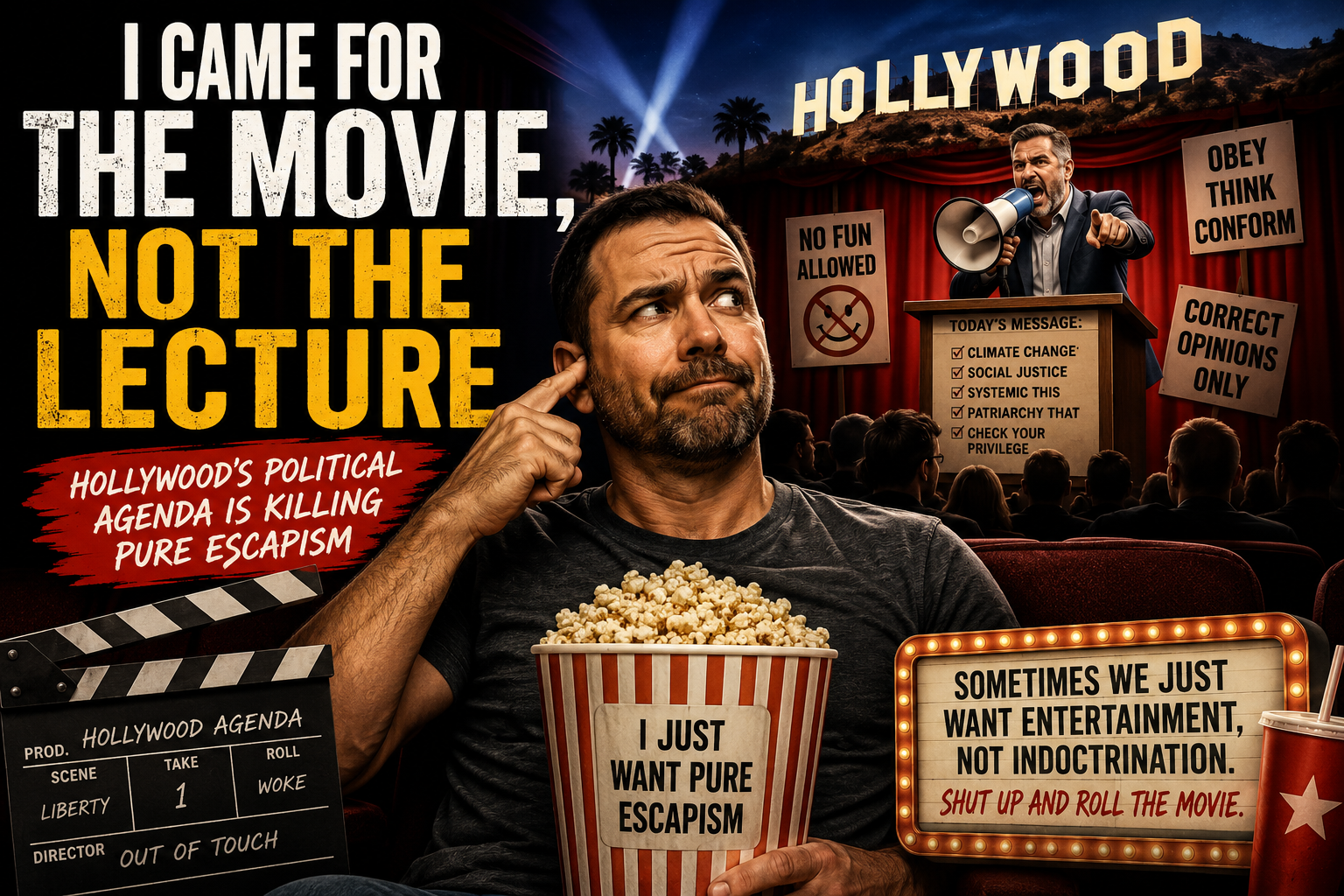
Hollywood, I already have taxes, social media, and cable news. Sometimes I just want to watch the giant monkey fight the giant lizard.
Entertain Me – There was once a wonderfully simple agreement between Hollywood and the American moviegoer. I gave them money, they gave me two hours during which I didn’t have to think about anything remotely important. It was a beautiful relationship. I’d walk into a theater carrying a bucket of popcorn large enough to bathe a toddler in, settle into my seat, and willingly surrender all higher brain function. Give me spaceships, gangsters, cowboys, car chases, dinosaurs, Clint Eastwood squinting at somebody, or Arnold Schwarzenegger firing 11,000 rounds without reloading. I wasn’t demanding realism, social commentary, or personal growth. I wanted escape.
Somewhere along the way, however, Hollywood apparently decided I was wasting valuable educational time. It was no longer enough for me to watch superheroes save the planet, detectives catch murderers, or beautiful people run away from explosions without ever getting their hair messed up. Apparently, every trip to the movies needed to become an opportunity for me to emerge a slightly more socially enlightened citizen. Now I occasionally sit down to watch a movie about superheroes, dolls, zombies, or dragons and get the uncomfortable feeling that somebody has hidden a sociology professor behind the television.
The problem isn’t that movies have ideas. Movies have always had ideas, and some of the greatest films ever made are deeply political. Dr. Strangelove skewered nuclear politics. Network went after television, corporations, and the commodification of outrage decades before social media turned those things into an actual business model. Platoon wrestled with Vietnam. Even Jaws gave us a politician ignoring an obvious public danger because addressing it might hurt the local economy, which becomes more believable with every passing year.
But those movies generally understood an important distinction: the message should serve the story, not hold it hostage.
Chief Brody never stops halfway through Jaws, turns toward the camera, and delivers an eight-minute speech about municipal regulatory failure and the corrupting influence of tourism dollars. There is a shark. The shark is eating people. Perhaps we should close the beach. We get it.
That’s called storytelling.
Whatever Happened to Subtlety?
The best movies trust their audiences enough to let us figure things out. Rocky has plenty to say about class, dignity, perseverance, masculinity, poverty, and the American dream, but Rocky Balboa never reaches the top of the Philadelphia Museum of Art steps and pauses to explain the socioeconomic significance of what we’ve just witnessed. He runs. The music swells. He raises his arms. We understand.
Modern Hollywood sometimes seems terrified to take that chance. It’s not enough to plant the metaphor anymore. The metaphor must be watered, illuminated by spotlights, surrounded by orange traffic cones, and accompanied by a character holding a sign reading THIS IS THE METAPHOR. Then everyone involved gives interviews explaining the metaphor just in case some poor guy in Omaha had the audacity to simply enjoy the movie.
That’s when political storytelling becomes irritating—not because a film has a viewpoint, but because it seems unwilling to trust me with it. I don’t mind a filmmaker slipping an idea into my head. That’s part of what good art does. I mind noticing the screenwriter standing behind the character with a funnel.
Don’t Look Up: Yes, We Understand the Comet
Adam McKay’s Don’t Look Up may be one of the clearest examples. Leonardo DiCaprio and Jennifer Lawrence play astronomers who discover that a giant comet is heading toward Earth, while politicians, corporations, television personalities, celebrities, and the general public respond with varying combinations of greed, denial, distraction, and stupidity. The comet is a metaphor for climate change, and I understood this relatively early in the proceedings.
The movie apparently wasn’t convinced.
The Guardian’s Peter Bradshaw called the film “laboured” and “self-conscious,” although climate scientists and activists were among those who strongly connected with its depiction of political inaction. The disagreement over the film is interesting precisely because it illustrates the difference between agreeing with a message and enjoying the way that message is delivered.
The comet represents climate change. Got it. Politicians ignore the comet. Still with you. Corporations discover they can make money from the comet. Understood. Television trivializes the comet. Yes, Adam, I promise I’m paying attention.
After a while, I half expected Leonardo DiCaprio to stop the film, walk down the theater aisle, kneel beside my seat, and personally ask whether I had any questions.
That’s the danger of beating an audience over the head with satire. Eventually, we’re no longer thinking about the idea because we’re too busy admiring the size of the hammer.
Barbie: Come for the Dream House, Stay for Gender Studies
Then there was Barbie, perhaps the only movie in history capable of turning a plastic doll, a pink Corvette, and Ryan Gosling’s abdominal muscles into a national debate about patriarchy.
To its credit, Barbie is frequently very funny. It’s visually inventive, Margot Robbie is terrific, and Gosling attacks the role of Ken with the commitment of a Shakespearean actor who has just discovered spray tanning. The entire movie looks like somebody gave an eight-year-old girl $145 million and complete creative control over Los Angeles.
Then Ken discovers patriarchy—and horses, although he appears considerably more interested in the horses.
The film’s politics are hardly hidden. The Guardian described it as a “candy-coloured feminist fable,” and discussions of the film naturally centered on its treatment of gender expectations and patriarchy. None of that is inherently a problem. Greta Gerwig made the movie she wanted to make, and audiences turned it into an enormous hit.
But Barbie also illustrates Hollywood’s modern reluctance to let an idea simply emerge from a story when somebody could explain it directly. America Ferrera’s famous monologue about the contradictory expectations placed on women became one of the most discussed moments in the film. For plenty of viewers, it was the emotional high point. For others, it was the moment somebody accidentally changed the channel from Barbie to TED Talks.
Imagine applying the same technique to classic films. Halfway through Rocky, Adrian sits Rocky down and says, “What you’re experiencing represents the struggle of the American working class to find dignity within entrenched socioeconomic hierarchies.”
Rocky stares at her for a moment.
“Yo, Adrian. I just wanna go the distance.”
Exactly. Now let the man punch the meat.
The Boys: The Satire Has Located a Megaphone
Prime Video’s The Boys started with one of the best satirical premises on television: What if superheroes were actually narcissistic celebrities controlled by corporations, lawyers, publicists, pharmaceutical companies, and marketing departments? Superman has a PR team. Captain America has focus groups. The Justice League is brought to you by Pepsi. That’s funny because the satire grows naturally out of a world we already recognize.
The series was political from the beginning, and creator Eric Kripke has openly discussed Homelander partly as a Trump analogue. By Season Four, however, some critics argued that the show’s political parallels had become increasingly heavy-handed; TV Guide, for example, described its satire as “remarkably heavy handed.”
That’s where satire can start losing its magic. A wink is funny. Someone repeatedly elbowing you in the ribs while asking, “Do you get it?” becomes exhausting.
Yes, I get it. Homelander represents authoritarian politics. Vought represents corporate manipulation. The television network is parodying partisan media. The rallies resemble real political rallies. I understand. Can we please get back to the psychotic guy with laser eyes?
When satire becomes too literal, it stops surprising us. If I already know which political faction is going to be mocked, what every character is going to believe, and what conclusion I’m expected to reach, I don’t need fictional politics. I can turn on cable news and watch the professionals.
Sometimes a Giant Lizard Is Enough
This is where Hollywood occasionally seems to misunderstand the desire for escapism. Wanting two hours away from politics doesn’t mean we’re incapable of understanding serious issues. Most adults deal with serious issues constantly. We have jobs, mortgages, children, aging parents, taxes, health insurance, retirement accounts, wars, elections, inflation, traffic, and group texts that somehow generate 73 messages while we’re trying to eat dinner.
Then there’s the smartphone, humanity’s ingenious invention for ensuring that every catastrophe occurring anywhere on Earth can reach us before we’ve finished our first cup of coffee.
By Friday night, I’m sufficiently informed.
I don’t necessarily need Batman to explain democracy to me. I need Batman to punch the Joker.
Sometimes Godzilla can simply fight King Kong because Godzilla is a gigantic radioactive lizard and King Kong is a 300-foot gorilla, and somebody had the magnificent idea of putting them in the same movie. I don’t require a twelve-minute conversation explaining what their battle represents about late-stage capitalism. It represents a giant monkey fighting a giant lizard. I have purchased an overpriced beverage and popcorn specifically to watch this happen. Please proceed.
Escapism isn’t intellectual cowardice. It’s one of the reasons storytelling exists. Human beings have always told stories about heroes, monsters, adventures, impossible journeys, revenge, love, courage, and redemption partly because reality is exhausting. Sometimes we want a story to challenge us, but sometimes we want it to carry us somewhere else.
Both are legitimate reasons to buy a movie ticket.
A Modest Proposal for Hollywood
So here’s my radical proposal for filmmakers: trust us again. Audiences aren’t stupid. If your movie contains an interesting political or cultural idea, there’s a decent chance we’ll notice. If some people don’t notice and simply enjoy the explosions, that’s okay too. Nobody needs to be detained in the lobby until they’ve correctly identified the allegory.
Put story before sermon. Give characters personalities instead of political assignments. Let heroes have flaws and villains occasionally make disturbingly good points. Let men be heroic without convening a congressional hearing on masculinity, and let women be strong without requiring another character to announce that a Strong Female Character has entered the room. Give us complicated human beings instead of representatives from opposing sides of a cable-news panel.
Most importantly, bring back ambiguity. Make us argue about what the movie meant while driving home instead of explaining everything before we’ve reached the parking lot. The conversation after a great movie should begin with “What do you think that meant?” rather than “Well, they certainly made their position clear.”
And every once in a while, make something that means absolutely nothing. I mean gloriously, magnificently, unapologetically nothing. Give me a treasure map, three guys with machine guns, a stolen Lamborghini, a Russian submarine, a beautiful woman who inexplicably knows karate, one extremely angry shark, and a retired Special Forces colonel whose daughter has been kidnapped by people who have made a catastrophic error in judgment.
The colonel doesn’t need a political affiliation. The shark doesn’t need a position on climate policy. The Lamborghini doesn’t need to symbolize capitalism.
Just tell me a great story.
We Came Here to Escape
That’s really all I’m asking from Hollywood. Entertainment doesn’t have to be meaningless, and movies certainly shouldn’t stop exploring important ideas. But neither does every superhero, sitcom, science-fiction series, children’s toy adaptation, and giant-monster movie need to enlist in the culture war.
Make us laugh. Make us nervous. Make us cheer. Give us heroes worth rooting for, villains worth hating, and stories good enough that we forget the glowing rectangle in our pocket for a couple of hours. Give us some mystery, adventure, romance, horror, courage, revenge, redemption, and occasionally something enormous exploding for reasons that don’t require a graduate seminar to understand.
When the lights come back on, we’ll return to elections, arguments, breaking news, social media, and whatever new crisis is supposedly going to destroy civilization by Tuesday. Reality will still be waiting for us in the lobby.
Until then, Hollywood, remember the old deal. I’ll buy the ticket and the absurdly expensive popcorn. You give me two hours somewhere else.
And if I want a political lecture afterward, don’t worry.
I still have Facebook...